Feeds:
Posts
Comments

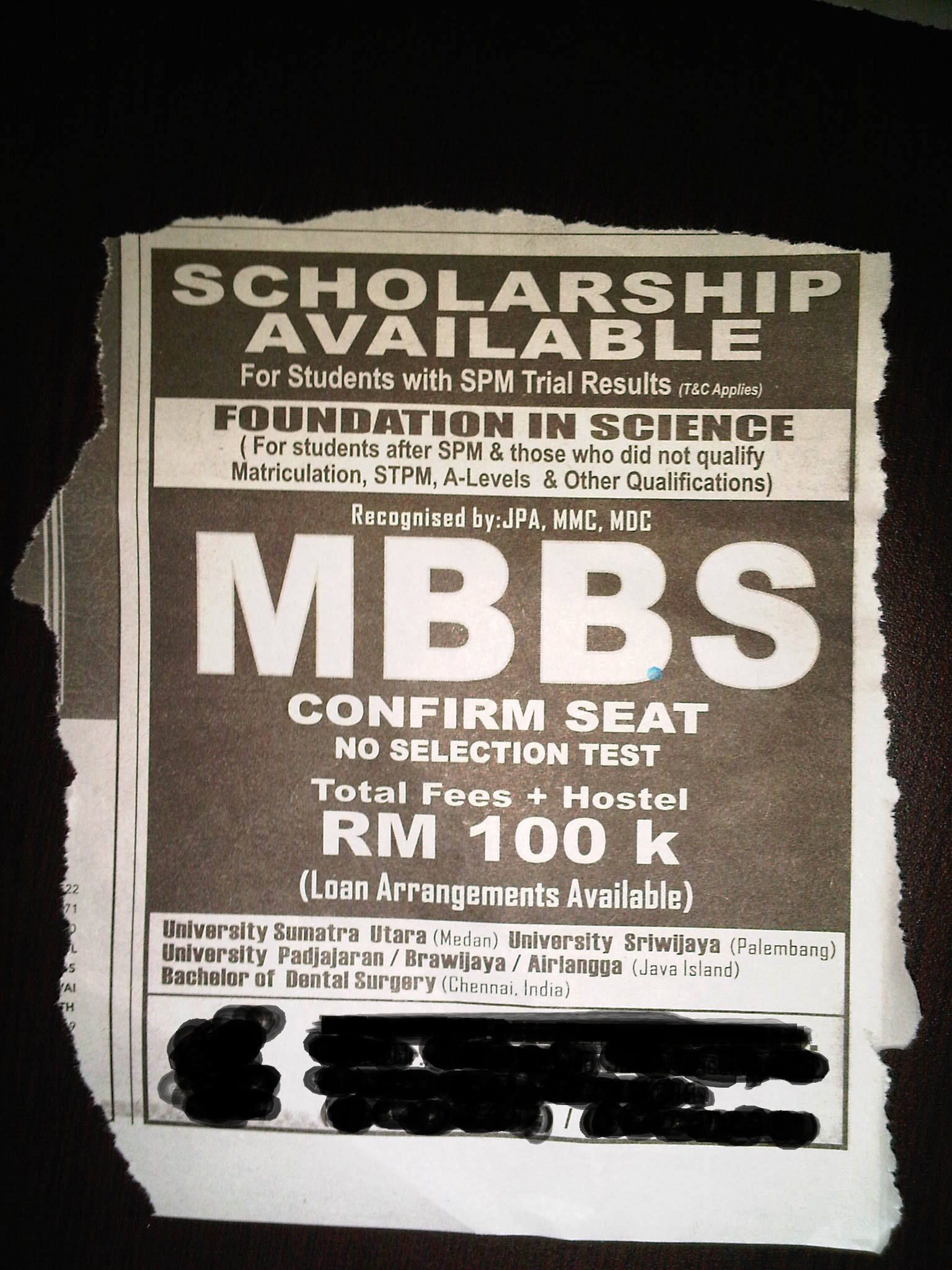
Here we go again and again and again………………Just when we are talking about oversupply of medical graduates soon , here comes another medical school. The following advertisement was in The Star yesterday, a new university offering medical course in the state of Perak. It seems it is a collaboration between the state government and a private sector.  In the same advert, you will notice that this “university” is also offering “Foundation studies”, the most famous course currently in Malaysia which I have blogged in my previous entry. Almost every private college and some public universities are offering these studies as an easier route to do medicine etc. When other countries are moving forward with graduate studies , we seem to be moving backwards . I even heard that some private colleges are offering a 6 months foundation programme in order to do medicine. There is no standardised Foundation programme like STPM/A Levels/IB etc etc in Malaysia. The curriculum, exams and even the marks are decided by the college itself and of course, your seat is guaranteed!

Welcome to the education hub of SEA!! Malaysia Boleh! Lets see how many graduates are going to be jobless in the near future, in all popular field! We just have too many universities with questionable quality with too little job opportunities. Poor human resource planning. Only the best will survive………………….

This is an interesting news that I saw in the Star today. Why a country as small as us need 8 flying schools producing 300-400 pilots a year ? Again, this is only possible in this Bolehland!  Do you also know that there are 9 universities offering Aeronautical Engineering course in Malaysia, each producing about 100 graduates? Where are they going to find their jobs? We are not an aeroplane/rocket producing nation?

Well, it has happened to nurses and now pilots and soon, it will be doctors who will be in unemployment list! Many still don’t agree with me when I said it is going to happen, but just wait and see, it will happen.

Graduate pilots hit hard by job shortage

EXCLUSIVE
By RACHAEL KAM, FLORENCE A. SAMY and TEH ENG HOCK
newsdesk@thestar.com.my

//

ABOUT 500 pilots earned their wings and aimed for the sky – only to see their dreams come crashing. The reality is that there are few openings and the job shortage has hit them hard.

Most of these pilots, who graduated from the eight flying schools in the country, have been without a job for between one and two years.

Other developments:

>       While the schools produced between 300 and 400 pilots annually in the last five years, their total intake for a year can reach up to 800.

> The biggest airline operator – Malaysia Airlines — only takes in about 100 pilots or so and its priority is its own trainee pilots.

>       The problem of surplus pilots will be further compounded when more join the group this year.

>       Don’t be idle, take courses to keep flying skills intact, Department of Civil Aviation flight operations director Capt Datuk Yahaya Abdul Rahman tells fresh pilots.

Every weekend when I flip through the newspaper (The Star), I just can’t ignore the small adverts that appears at some corners of the newspaper, for those who wants to do medicine! I am so embarrassed and disgusted to see how low medicine has gone. From a well-respected and noble profession to something that goes along with a motto “ Now, everyone can become a doctor………………….” Medicine which use to be done by the creams of the country, has now gone down so low that anyone with a low qualification and money, can become one.

These adverts sometimes make me wonder whether parents have become so stupid in order to make their child a doctor at whatever expense?  If you look at the adverts below, some even guarantees a seat despite not being able to get a seat for A-Levels, STPM and Matriculation!! What does this mean? That the students are so stupid not being able to get a place in these pre-U courses but can still do medicine with a guaranteed seat ,100K total and no selection test? Sounds ridiculous to me!

In most countries, there are only few selected Pre-U courses that are recognised to enter universities. Unfortunately in this Bolehland, anyone can come up with a Pre-U programme to make money. The famous Pre-U programme now is ” Foundation in Science“!. Almost every private college in Malaysia seem to be offering this course with guaranteed seat in their medical course. Please go to some of the private medical schools websites and you will see this. It is really disheartening to know that the Ministry of Higher Education does not monitor these courses and allows so many such courses to appear. So, why struggle to do A-Levels or STPM? Just do a Foundation programme in a private college where you know your medical seat is guaranteed! BTW, who monitors these foundation programme curriculum and exam standards?

Whenever someone ask me about this, I always tell them that it is the safest to do STPM, A-Levels or IB. These are the safest Pre-U courses and internationally recognised. The other options will be SAM(South Australian Matriculation) or AUSMAT, which is a 1 year programme and also recognised in many universities especially Australian Universities. If you do the so-called “ Foundation Programme” in some of the local private universities, please be aware that it is not recognised by any other universities either locally or internationally. Thus, if you want to change course etc, you will not be able to get a place elsewhere.

Another Malaysia Boleh mah……………….., now you know why we are going down the drains………………… I just can’t wait to see jobless doctors soon and make some parents to realise what mass they have created for their child!!

 I received this joke below from one of my friend. I am not sure how many of it is the truth but definitely worth having a good laughter!

DS Samy Vellu finally and officially resigned from his post of the longest MIC President ever live, after leading the party for almost 31 years. The Malaysian Insiders has its story, here . Frankly, I will miss him very much especially for all his funny quotes he made all these years. Like what our Prime Minister said in the 2010 Barisan Nasional Conference, “We will miss DS Samy Vellu because he add a lot of color … sometimes a bit too much color”. Therefore, as a token of appreciation, I just wanna share his famous quotes ever made by the one and only, Samy Vellu.

1. Samy Velu quoted on Pos Laju:
“Besoh kirim, hari ini juga sampai”

2. On one TV news when he tried to say he felt very ashamed:
“Ini prekara sangat memalukan saya dan kemaluan saya sangat-sangat la besar”

3. Samy said in one of his “ceramah”:
“Kita akan bina satu jambatan wuntuk worang2 kampong di sini.” Then one pakcik asked, “Datuk, sini takde sungai, buat apa bina jambatan?” And Samy gloriously replied, “Kalao takde sungai, kita bina sungai”

4. Samy’s most favourite quote on the news for the decade is this:
“Toll naik sikit, banyak marah saya. You worang ingat semua ini toll saya punyer bapah punya kah!”

5. During water crisis:
“Semua worang diminta jangan membuang aiyerr!”

6. On social society’s problem:
“Worang2 muda sekarang banyak suka hisap dade”

7. During blood donation’s program at Sungai Siput:
“Marilah kita semua menderma dare”

8. His welcome speech in most of his functions:
“Selamat datang saudara-mara semua” (It should have been “saudara-saudari”)

9. During the height of the Al-Arqam’s saga, he said in a press conference:
“Saya gumbira bahawa didapati tiada pemuda MIC terlibat dalam kes Arqam”

10. At an opening ceremony for a new building:
“Mempersilakan Datin Paduka Rafidah Aziz naik dari pentas wuntuk membuka 

kain”

And of course the world’s greatest joke of all times:

“Kita akan bina roket pigi matahari.” One of the reporter responded, “Tapi Datuk, matahari terlalu panas untuk didekati.” Samy replied, “Itu tade masalah. Kita hantar waktu malam”

There you are folks. For DS Samy Vellu, we wish you all the best!

As I have said before, soon the government will introduce a common exam for all medical graduates from overseas. The news in Star today by our Director General of Health is the clearest indications of that. However, we need to wait till the Medical Act is amended, which will likely take place this year or after the general election.

BUT I do not agree that this will only apply for the foreign medical schools. No doubt that it is difficult to monitor the quality of foreign medical schools by the Malaysian Medical Council. As such, like most other countries, the best way will be to ask everyone who graduate from overseas to sit for a common exam to be able to get a job in Malaysia. I wonder whether it will apply for JPA and MARA scholars as well but usually JPA students should not have any problems as they are the top students in the country. Can’t say the same for MARA students as the drop out rate for MARA medical students internationally is almost 30% (this info is from MARA itself).

I feel the MMC should come up with a structured exam for the local private and public universities as well,or at  least have periodic inspection to monitor their lecturer ratio, teaching quality and entry qualifications. The quality of their graduates should also be monitored. With unemployed doctors being a distant reality, I just hope parents will stop thinking that medicine will give their child a luxury life!

Exam for docs won’t cause brain drain

By LOH FOON FONG
newsdesk@thestar.com.my

PETALING JAYA: A proposed amendment to the Medical Act to compel all overseas medical graduates to sit for a common licensing examination will not worsen the brain drain situation, Health Ministry director-general Tan Sri Dr Ismail Merican said.

“The Malaysian Medical Council examinations are not meant to make things difficult for them but to assess their core knowledge. They should not worry if they have passed their university examinations,” he said.

Dr Ismail, who is also Malaysian Medical Council president, said in view of the weakness in monitoring foreign institutions, the council had proposed to do away with the Second Schedule of the Medical Act, containing the list of recognised foreign medical schools.

“Students can choose any university they wish to attend abroad but they have to sit for and pass a common licensing examination before being accepted for registration,” he said, adding that this was practised in many developed countries.

The proposed examination, which would be different from the current Medical Qualifying Examination for students from unrecognised universities abroad, would ensure that doctors were “fit to practise” as safe and competent doctors, he said.

Recently, Health Minister Datuk Seri Liow Tiong Lai said the examination was one of the proposals it was looking into when amending the Act.

Although the Malaysian Medical Association and senior doctors had suggested that all medical graduates be made to sit for a common examination, Liow said it would only apply to overseas graduates.

It was not necessary for local graduates to sit for the examination as local institutions were easier to monitor, officials said.

However, senior doctors advocated otherwise, claiming that local schools could lower passing grades to make their universities look good.

Recently, The Star reported on the lack of training hospitals to meet the influx of housemen and a doctor had expressed concerns that some graduates lacked core knowledge and could jeopardise patient safety.

Asked where people could get advice on medical schools that met the country’s requirements if the Second Schedule was removed, Dr Ismail said they could get this from colleges and the council.

The article below was written by Dr Milton Lum in The Star today. His views were exactly what I have been saying all this while. Too many medical schools with too few academics to give proper quality teaching and guidance. However, I feel the number of medical schools that he quoted is wrong. As of my calculation, it should be at least 28 and not 24. I think he has not included Masterskill, Kolej Insaniah and SEGI college which have just started their recruitment last year and of course John Hopkins University (also known as Perdana UNiversity). This means we have the highest number of medical schools per capita of the population, in the world perhaps! We must also understand that most of the other countries’ medical schools( like UK, Australia etc) recruits foreign medical students as well and thus not confined to producing doctors for their own country. Furthermore, the entrance criteria is strictly controlled by their respective medical council. This is totally different in our country where almost 95% of the students are locals as our degrees are not recognised elsewhere except Monash Malaysia which is recognised in Australia /N.Zealand and of course, with poor control of the entry qualifications.

I personally like this statement ” With the current rate at which Malaysian doctors are graduating from medical schools, both locally and abroad, the country will reach its overall doctor population target of one doctor for 600 population within three to four years, and a ratio of one doctor for about 400 population or less by 2020.There will have to be 5,000 to 7,000 Medical Officer posts in the public sector available annually within the next five years for the young doctors after completion of their housemenship training, and after that it will be anybody’s guess.If there are insufficient posts, how many can be absorbed by the private sector, which is already saturated in many areas?There will be no employment problems for doctors of good quality, but the prospect of unemployment is a possibility for the mediocre, and possibly, some of the average ones.”.

 I have been saying this all along and some people still think that their job is guaranteed after graduation!! Many of my prediction has come true. Just wait for this one to come true as well, probably by 2015. I think we will achieve a ratio of 1: 400 before 2020!

Quality first, not quantity

By Dr MILTON LUM

Recent media focus on the number of housemen and the attitudes of some of them raises questions about the quality of medical education, and by extension, the quality of healthcare patients will be receiving in the future.

ONE of the basic principles taught to all medical undergraduate and postgraduate students is Primum non cere, ie, first do no harm. It is a reminder to doctors to always consider that an intervention can lead to harm to the patient, however well intentioned it may be.

This principle is even more relevant today than in yesteryears.

Prior to World War II, the doctor’s responsibility to the patient was relatively simpler. It involved making a diagnosis and prescribing a treatment, which the patient may or may not respond to, depending on the patient’s physical state, and the illness he or she was suffering from.

In spite of the fact that there was, and still is, a marked shortage of medical educators in Malaysia, the expansion of medical schools has continued unabated.

It was not very different from a lottery. Medical knowledge and the range of diagnostic and therapeutic modalities then were limited. Specialists and other healthcare professionals, apart from nurses, were almost unheard of, and their services were only available to the well heeled.

There has been an explosion in medical knowledge, and the range of diagnostics and therapeutics has increased tremendously. Healthcare is one of the fastest growing sectors of many economies and is provided in many instances by a team of healthcare professionals, led by the doctor.

Specialists and specialty services are available in almost every nook and corner of the country, and if not available, access is provided by the state through ambulances and flying doctor services in the more remote areas.

Modern healthcare, however, is not without risks. The publication of To err is human by the Institute of Medicine in the United States in 1999, and similar reports from the United Kingdom and Australia, drew attention to adverse events that resulted from medical errors, the causes of which were human factors and system failures.

It is now generally accepted that the incidence of adverse events from hospitalisations is about 10%, with single digit figures for mortality and morbidity.

This was summed up succinctly by Sir Cyril Chantler in 1998: “Medicine used to be simple, ineffective, and relatively safe. Now it is complex, effective, and potentially dangerous.”

There are currently 24 medical schools providing undergraduate training for Malaysia’s population of 28 million. Countries with similar populations like Australia (22 million), Taiwan (23 million) and Canada (34 million) have 19, 11, and 17 medical schools respectively. – Source: United Nations

Recent media focus on the number of housemen and the attitudes of some of them raises questions about the quality of medical education, and by extension, the quality of healthcare patients will be receiving in the future.

The solutions announced to date are interim measures that do not adequately address fundamental issues which have their genesis upon the students’ admission into medical school. This article seeks to draw the reader’s attention to some of the issues and challenges that need to be addressed.

Learning medicine

There are more applications for entry to medical schools worldwide. Many young people want to become doctors, whether of their own volition, or at the behest of their parents.

High academic qualifications are the sole criteria for admission to all public medical schools in Malaysia, except University Sains Malaysia (USM), which requires an interview as well.

In general, the private medical schools also require high academic qualifications and an interview as well. Some also require applicants to pass an aptitude test.

Although the minimum academic qualifications for entry into medical schools are prescribed by the Malaysian Qualification Agency (MQA), there are claims of non-compliance by some private medical schools. There are also claims that some private medical schools take in more students than permitted.

The situation in foreign medical schools is varied.

Medical schools in advanced economies adhere strictly to high academic requirement, as well as assessments of the aptitude of the applicants.

However, some medical schools in developing countries admit students whose academic results would not even qualify them to enter a university in Malaysia for other courses with lesser entry requirements. Many of such students gain entry through the agencies of these medical schools.

It is necessary to emphasise that selection for entry into medical school implies selection for the medical profession. Findings from studies worldwide confirm that although some students have achieved the academic standards required for entry into medical school, they are not suitable for a career in medicine. It is in the interest of the public and such students that they should not gain admission, rather than to have to leave the course or the profession subsequently.

The issues and challenges that need to be addressed include:

● Should academic qualifications be the sole criteria for entry into medical schools?

● What is the role of interviews and/or aptitude tests?

● How robust is the monitoring of the compliance of Malaysian medical schools to the MQA’s minimum entry qualifications?

● How robust is the monitoring of the adherence of foreign medical schools to the MQA’s minimum entry requirements?

● What should be done to Malaysians admitted to local and/or foreign medical schools without MQA’s minimum entry requirements?

Medical schools

There are currently 24 medical schools providing undergraduate training for Malaysia’s population of 28 million (Source: International Medical Education Directory). Countries with similar populations like Australia (22 million), Taiwan (23 million) and Canada (34 million) have 19, 11 and 17 medical schools respectively (Source: United Nations).

Although there was a dichotomy between public and private medical schools in Malaysia previously, the margins have been blurred in the past few years. Some public medical schools have established twinning arrangements with universities abroad and the fees for students who enrol in such courses are not different from that charged by private medical schools in Malaysia.

Our ASEAN neighbours, Indonesia, Singapore, Thailand, and Philippines with populations of 238 million, 5 million, 67 million, and 94 million respectively have 35, 2, 12, and 41 medical schools respectively.

With the establishment of more medical schools already approved by the Higher Education Ministry, Malaysia may soon join the ranks of countries like Germany, Italy, and the United Kingdom who have 41, 42, and 44 medical schools respectively for populations of 82 million, 60 million, and 62 million respectively.

The issue is compounded by the fact that the government recognises more than 370 medical qualifications worldwide. The list of recognised medical schools was inherited from our colonial masters and added to over the years.

In addition, graduates from unrecognised medical schools can sit for the Medical Qualifying Examination (MQE) of the Malaysian Medical Council (MMC) and, upon passing, will be registered. The examination is the final year examination of the Universiti Malaya, Universiti Kebangsaan Malaysia, and University Sains Malaysia who conduct the examination on behalf of the MMC.

There are some who question the validity of these examinations. However, they have not provided any material to substantiate their suspicions. An analysis would reveal that those who fail the MQE usually have very poor results at SPM and STPM levels.

In spite of the fact that there was, and still is, a marked shortage of medical educators in Malaysia, the expansion of medical schools has continued unabated. Some private medical schools have teaching staff who are mainly foreigners from Myanmar, the Indian sub-continent, and the Middle East. Some of them do not speak any of the local languages, and some have no previous teaching experience.

It is not only the number, but also the quality of medical educators that is crucial in producing doctors that will make a positive impact on the public’s health. Medical educators are role models for students. It is well known that a deficient doctor is reflective of a deficient teacher; just as a child’s conduct is reflective of the parent’s.

Local medical schools are given time-limited accreditation after assessments by teams comprising representatives from the Malaysian Qualification Agency, Health Ministry, and the MMC.

However, it is impossible to accredit all the foreign medical schools recognised by the Government for manpower, logistical, and financial reasons.

Most governments in developed economies recognise their limitations in assessing the quality of medical education of foreign medical graduates. They require all those who want to practise medicine, particularly foreign graduates, to pass a licensing examination.

Many Malaysian doctors who have practised abroad, particularly those above 40 years, have passed these licensing examinations without difficulty simply because of the quality of medical education they received.

Many in the medical profession have stated publicly their concern that there is more emphasis on the quantity instead of the quality of the graduates. The consequences in other areas of studies may not be significant, but in healthcare, it can be a matter of life and death for a patient or potential patient, which means all the population.

The issues and challenges that need to be addressed include:

● How many doctors does the country need, and by extension, how many medical schools does the country need?

● What is the quality of medical education in recognised local medical schools, and how robust is its monitoring?

● What is the quality of medical education in recognised foreign medical schools, and how robust is its monitoring?

● Should not all medical graduates, particularly those from foreign medical schools, whether recognised or unrecognised currently, be required to pass a licensing examination before they are permitted to practise in Malaysia?

● What is the role of agencies of foreign medical schools and how robust is its monitoring?

Housemenship

During the course of the newly graduated doctors’ future practice, there will be continuing advances in medical science and clinical practice, healthcare delivery and financing, increasing expectations of patients and the public, and changes in societal attitudes.

The MMC has listed five basic ingredients of Good Medical Practice. They are professional integrity, communication skills, ethical behaviour, treating patients with dignity, and being a team player.

By itself, the basic knowledge and skills taught in medical schools is insufficient. The housemenship period is the time to make a start in the development of the ingredients of Good Medical Practice.

Young doctors have to develop his or her professional competences, skills, and behaviours so that they are better placed to serve and improve the care and health of their patients. They have to learn to always put the interests of their patients first and that the doctors’ professional practices affect the experiences of patients and their families.

The skills of continuing professional development have to be developed so that their practices can advance in accordance to changes in medical knowledge and practices.

In short, the housemenship period is a time when the newly graduated doctor transitions from theory to practice.

Learning during the housemenship period is not only from books and journals, but also experiential, with the latter playing a significant role. There has to be sufficient quality teachers for this aspect of the young doctors’ training. The teachers, who are usually specialists, have a crucial role to play as they are role models for young doctors.

There has to be exposure to sufficient numbers of patients for young doctors to gain the experience required for independent practice. For example, they have to be exposed to the different ways in which the common conditions, appendicitis and urinary tract infections, present. Failure to make an accurate diagnosis will lead to threats to life, in the case of the former, and long term consequences, in the case of the latter.

When there are few patients relative to the many housemen, it will, inevitably, have a negative impact on the latter’s training.

The statement of Sir William Osler, the father of modern Medicine, is particularly relevant: “Medicine is learned by the bedside and not in the classroom. Let not your conceptions of disease come from words heard in the lecture room or read from the books. See and then reason, and compare and control. But, see first.”

Many specialists report that they find it increasingly difficult to cope with the dual tasks of providing care to patients and training housemen, with the former always having to take priority over the latter. It is disconcerting to hear some specialists state that they do not even know the names of some housemen assigned to their wards and clinics “because there are so many of them!”

The issues and challenges that need to be addressed include:

● How many housemenship training hospitals does the country need?

● How many specialists are needed for housemenship training?

● What is the quality of housemenship training and how robust is its monitoring?

Too many doctors?

With the current rate at which Malaysian doctors are graduating from medical schools, both locally and abroad, the country will reach its overall doctor population target of one doctor for 600 population within three to four years, and a ratio of one doctor for about 400 population or less by 2020.

There will have to be 5,000 to 7,000 Medical Officer posts in the public sector available annually within the next five years for the young doctors after completion of their housemenship training, and after that it will be anybody’s guess.

If there are insufficient posts, how many can be absorbed by the private sector, which is already saturated in many areas?

There will be no employment problems for doctors of good quality, but the prospect of unemployment is a possibility for the mediocre, and possibly, some of the average ones.

When the costs to the state or to the individual of producing one doctor are considered, the question arises whether it makes economic sense to flood the market with doctors. The laws of supply and demand do not apply to doctors simply because doctors are not only suppliers but also play a significant role on the demand side of the equation.

Studies from the developed economies have shown that a small number of doctors account for the majority of complaints and medical errors, where human factors are involved. Poor quality doctors will inevitably contribute to medical errors, morbidity, mortality, and consequential increase in healthcare expenditure.

Going forward

The current problem of housemenship training has its genesis in medical schools. It raises questions and challenges about the quality and quantity of medical graduates, some of which have been discussed above.

The resolution of the problem can only be possible if a comprehensive approach is taken. Ad hoc measures will not solve the problem. Moratoria and increasing the number of hospitals for housemenship may be part of the solution, but they are at best, interim measures.

The fundamental issues have to be addressed before the situation gets out of hand.

Medical schools have to be held accountable for the quality of their graduates. The principle that society’s health is more important than profits has to be adhered to at all times, particularly by the private medical schools.

We owe future generations a healthcare delivery system founded on patient safety and quality of care in which quality doctors have a crucial role to play. The consequences of having significant numbers of poor quality personnel in other areas of human activity may not be significant, but in healthcare, it can be a matter of life and death for all the population.

Dr Milton Lum is a member of the board of Medical Defence Malaysia. This article is not intended to replace, dictate or define evaluation by a qualified doctor. The views expressed do not represent that of any organisation the writer is associated with.

There is a famous hospital down here which I have talked about in my “Are we going back to 3rd World?” series. The angio machine has not been functioning since August 2010, if I am not mistaken. One of the cardiologist got so frustrated , bypassed his boss (who doesn’t do anything!) and wrote an email directly to the DG. Some actions were taken and the hospital has just received a new set of angio machine. But wait! Guess what? The door is too small to bring in the angio machine and thus it is left at the car park to be cooked under rain and sun! I guess it is worth at least 1-2 million! Well done ! Please continue to pay your taxes!

I just received an interesting info that something is cooking in one of the private medical college in Klang Valley. It seems that this medical college accepted 236 students for 2010 intake when they are only allowed to take a maximum of 150 students! Malaysian Medical Council (MMC) has issued a warning to this medical school to either remove this extra 86 students or face derecognition. Thus 86 students are advised either to switch discipline, transfer to another university or rejoin next intake of 2011!!! you can view some info from these blogs: http://paulineng91.blogspot.com or http://nazirahkamil.blogspot.com/2011/01/very-tragic-ending-of-2010.html.

I have said this many times, private medical colleges are just here to make money, period! I can assure you that NONE of the private medical colleges including some public medical colleges have enough full-time lecturers to even take more than 50 students! On paper, the figures are manipulated by including part-time lecturers as well as consultants from the attached government hospitals. I still feel that medical education should never be commercialised. In most developed countries, all medical colleges are public universities and their standards are maintained by regular accreditation from their respective medical councils. Unfortunately, in this Bolehland, everything is possible. You can rent a few shop lots and start a medical school as long as you have enough cables to pull…………………….. God bless!

 First of all, I would like to wish everyone a very Happy New Year 2011. It has been a while since I last posted anything on my “For Future Doctors “series, the last being on “Housemanship Glut”. I have been observing all the comments and enquiries that were posted in my blog regarding my articles. I had many interesting questions by medical students as well as houseofficers regarding their future prospect in medicine. I thought of answering some of these queries’ in this posting.

 What if I quit Housemanship?

I had a couple of housemen who asked me what will happen to them if they quit housemanship and what the other options are. According to Medical Act 1971, a medical graduate has to complete 1 year housemanship in order for them to receive their full registration under the Malaysian Medical Council. This has been increased to 2 years since 2008 (officially). I am not sure whether it is legally binding as the Medical Act 1971 has yet to be amended.

What will happen if you quit housemanship? The answer: You will NEVER be able to practise as a doctor anymore. If you quit housemanship, you will not get your full registration which means you will never be able to practise legally. Thus, whatever you have studied over the last 5-6 years is just a waste. It would have been better if you had decided much earlier that medicine is not your field and switch course during your undergraduate period. There are 2 parties to blame here, yourself and your parents.

Basically, you need to find another job or undergo another undergraduate training in another course. One of the person who wanted to quit housemanship asked me whether she can do Master’s programme in preclinical studies such as Physiology (Master’s in Medical Sciences) or Anatomy and subsequently become a lecturer. The answer is yes and no. Of course you can but in order for you to get a place for Master’s programme in Malaysia, you must be in service. You must have undergone at least 3 years of service with full registration and need recommendations from Head of Department as well as good SKT marks before being able to apply for the programme. As such when you quit housemanship, this is NOT possible especially when our Master’s availability is very much limited with high demand. Probably you can try overseas universities but however, the degree offered must be recognised in Malaysia as a postgraduate degree.

 Can I join Pharmaceutical companies? Again it is a possibility. In fact, with oversupply of doctors in Malaysia in a few years’ time, we might be seeing a lot of medical graduates joining pharma companies to get a job. Sometimes, pharma companies also need you to have full MMC registration in order to join them.

 Can I become a Lecturer by just holding a MBBS? The answer is NO. As I have said before, medicine a very peculiar field. If you are an engineering graduate, can’t find a job, you can be made as a lecturer if the university wants to. Of course an engineering graduate without field work is going to be a useless teacher but who cares in this Bolehland. I have seen so many engineering graduates who have become lecturers the day after they passed out! No wonder we have so many buildings collapsing. I also have seen many engineering graduates becoming school teachers. But for medicine this is not possible. Only doctors with postgraduate degrees are allowed to become lecturers, internationally and of course you will never be accepted as school teachers. But, who knows………………… in Bolehland anything can happen.!

 Usually, my general advice to whoever decides not to continue as a doctor is to at least complete your housemanship, whether you like it or not!


What if doctors become jobless in the next 5 years?

 To me, this is a distant reality. There were some comments which said that doctors will never become jobless but will become lowly paid. Remember, in Malaysia doctors has to join civil service in order to do your housemanship. Under the Medical Act 1971, housemanship can only be done in government hospitals.

 It is a 2 parallel system. After you graduate you need to apply for a post in civil service which is done by the Public Service Commission (SPA). Only when SPA accepts you into the civil service, the Ministry of Health will decide on your posting and place of training. This is where it gets a little bit tricky. If you read my article in MMA written in July 2006: “Future of Government Doctors: Die Another Day!” (https://pagalavan.com/my-mma-articles/july-2006future-of-government-doctors-die-another-day/), there is a limit to the number of post that is available. The number of post in the government sector is NOT limitless.

 We are already suffering from an over bloated civil service. We have one of the highest numbers of civil servants in the world, compared to our population. Housemen start at UD41 grade in civil service. Due to recent promotional prospect, all medical officers have been pushed to UD44 grade and thus creating more vacancy in UD41 grade for houseofficers. But this vacancy has a limit and the government is not going to keep increasing the number of post as they need to consider the financial implications.

 Thus, there will come a time where medical graduates will become jobless in Malaysia if the current trend continues. Despite a stop in new medical schools, the existing medical schools (total of 32) will continue to increase the number of graduates as it is a money-making business. Doctors will become like lawyers in another few years’ time.

 If you don’t believe me, just take a look at nurses. About 10 years ago, the shortage of nurses made headlines in newspapers. The government began to approve private nursing colleges. Now, we have almost 100 over nursing colleges in the country so much so, you can get a place with just 1 credit in your SPM. At the same time, you are also seeing many nurses with no quality at all, can’t speak/write English and totally unemployable. There are so many unemployed nurses in the country at the moment, some even working in petrol stations! These nurses were guaranteed a job in government sector by the private colleges. However, only nurses trained in KKM nursing colleges are given priority to be absorbed into government sector. The rest has to queue up to get a job in civil service. The private sector is also full. The big private hospitals such as KPJ and Pantai have their own nursing colleges and they will absorb their trainees.

So what happen to the rest? Jobless lah………………………..

Next in line: will be medical graduates……………….!

The stats helper monkeys at WordPress.com mulled over how this blog did in 2010, and here’s a high level summary of its overall blog health:

Healthy blog!

The Blog-Health-o-Meter™ reads Wow.

Crunchy numbers

Featured image

About 3 million people visit the Taj Mahal every year. This blog was viewed about 54,000 times in 2010. If it were the Taj Mahal, it would take about 7 days for that many people to see it.

In 2010, there were 110 new posts, not bad for the first year! There were 63 pictures uploaded, taking up a total of 46mb. That’s about 1 pictures per week.

The busiest day of the year was September 10th with 2218 views. The most popular post that day was For Future Doctors: General Misconception of being a doctor Part 1.

Where did they come from?

The top referring sites in 2010 were facebook.com, medicine.com.my, zorro-zorro-unmasked.blogspot.com, google.com.my, and mail.yahoo.com.

Some visitors came searching, mostly for pagalavan, mariam mokhtar, columbia asia hospital nusajaya, pagalavan blog, and columbia asia nusajaya.

Attractions in 2010

These are the posts and pages that got the most views in 2010.

1

For Future Doctors: General Misconception of being a doctor Part 1 September 2010
18 comments

2

For Future Doctors: General Misconception of being a doctor Part 2 September 2010
33 comments

3

About Me January 2010

4

For Future Doctors: General Misconception of being a doctor PART 1 September 2010
7 comments

5

For Future Doctors: Housemanship, Medical Officer and Postgraduate Training (Part 3) November 2010
101 comments