Feeds:
Posts
Comments

Archive for the ‘Education’ Category

World Arthritis Day 2011

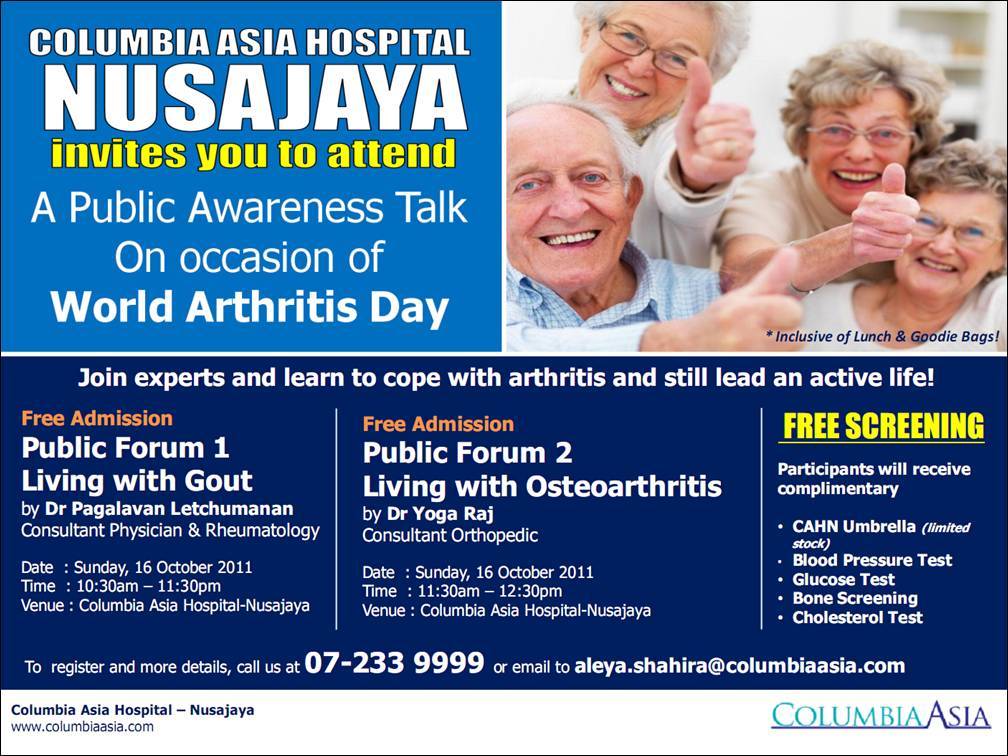
World Arthritis Day is on 12/10/2011 and the Arthritis Foundation of Malaysia(AFM) usually organises public forums to educate the public in creating awareness of various musculoskeletal diseases in Malaysia. For the first time in Johor, on behalf of AFM, I will be organising a public forum this coming Sunday 16/10/2011 in my hospital , Columbia Asia Hospital Nusajaya.

We chose 2 very common arthritic problems that the general public faces: Gout and Osteoarthritis. See below for more info on this forum. Admission is free and all those who are staying in JB are welcomed.

Read Full Post »

Didn’t I say , it is coming. It is official that the compulsory service for Pharmacist will be reduced from 4 years to 2 years ( including housemanship). This was announced today by MOH. If I am not mistaken, the compulsory service for pharmacist was introduced in 2004 due to shortage of pharmacist in the government sector. In just 6 years, they have reduced it back. It was reported in Bernama that 90% of the post in government sector has been filled!! I know pharmacist are now functioning as dispensers in many government hospitals and some klinik kesihatans have 2 pharmacist!

So, the government is now allowing them to resign earlier to enter private market. Another knee jerk reaction for poor planning! Unfortunately the private market is not that great either. Most private hospitals only need 1-2 pharmacist to run the show. Same goes to the retail outlets. So where are these pharmacist going to go? Is this the prelude to stopping dispensing rights to GPs? Once there are a lot of jobless pharmacist out there, the government may just stop allowing doctors to dispense medications and insist on GP clinics to hire pharmacist. Well, doctors are next in line……….. I am already hearing rumours of compulsory service being scraped for doctors.

 http://www.bernama.com.my/bernama/v5/newsindex.php?id=618149

Pharmacists’ three-year stint with Govt reduced to one

KUALA LUMPUR: The requirement for pharmacists to serve a mandatory three years with government hospitals after they graduate has been reduced to a year.

Health Minister Datuk Seri Liow Tiong Lai said the cabinet had approved the decision in early September. It will take effect immediately.

However, he said, the one-year training before the compulsory service would still be maintained.

Read Full Post »

I am a UK graduate and I’ve been working in Malaysia for almost a year. On my first day, I called my MO by her first name (respectfully) to ask her a question, and she did not answer, so I asked again, and she said to me ‘I would like to be addressed as Dr xxx’. For someone who has been calling all doctors, even my consultants in medical school by their first name, how lame that is, I thought. But I’m used to that now. Just because I am addressing them by their title doesn’t mean that I respect them all of them, especially ones who are obviously empty tins. If I disagree with something, I will say it out.

In Malaysia there is this thing that HO should round early in the morning first, then the MO will round again (which we are suppose to follow and write), then again with the reg and the specialist. I have never encountered anything like this where I studied. There is just so much repetition here. What is the problem with everyone just arriving at the same time and then we do ONE single round together? Are consultants too mighty high to be asking questions or examining patients? Yes, the juniors should know and present the cases, but so should the specialists and the consultants. Here, we come at 6:00-6:30am in the morning to see all the patients, then there will be another 2 or 3 rounds with people more senior than us so we can ‘update’ them patient condition so that they are able to add on their own management plan. Most of the specialist/consultant would just stand at the bedside listen to the juniors present, bombard lots of question, dictate some plans then move on, without even saying a word or looking at the patient. Then when the intimidating boss-like figure is finished, the patient would rush to ask me what had he just muttered before I had to rush off to tail ward round. In the UK, junior doctors come half an hour earlier than the consultant to get the investigations results ready and find out if anything happened overnight/over the weekend, then wait for the consultant to turn up to start the round. If it is a non-consultant round, everyone would get on with the round as a team. There is no such thing as HO to see the patients before the reg. There, the registrars, SHO and HO help each other out so they finish their work as quickly as possible. Isn’t that a much more efficient use of everybody’s time? Once, my nice MO was helping me with a particularly difficult IV line, and another MO asked him ‘why are you doing HO’s work?’ You see the attitude? Don’t get me started on the TDS round. Yes, they do rounds three times a day here (in most specialties), sometimes x 3 due to the hierarchical arrangement as I have mentioned above.

The worst part is having to play the servant for MO/reg/specialist/consultants. In my hospital, HOs have to regularly to go the record department to trace files for the reg’s case presentation/ write up. Last week, my friend had to go to my specialist’s car to fetch a stack of photo frames to her office. In departmental census, the HOs does all the data collection (trawling through the case records) not knowing the end results whilst the boss gets to present and publish. We call patient up to inform op date, cancelled op, rearrange op so often I thought we sounded like a professional telephone operator. You can’t blame me for cursing under my breath whilst performing these stupid errants.

In Malaysia, HOs are unappreciated slaves. Everyone, senior and junior figures in the medical profession, should rethink the way we are doing things here. You may say the practice has stood the test of time but is it really worth wasting so many hours for sometimes so unproductive as three morning ward rounds in a day just because of hierarchy? Is it fair to treat HO as your servant doing your secretarial job? Are MO/Reg/Specialist incapable of occasionally helping your new HO make some referrals or write a prescription or ask for a CT scan, or God forbids, take blood? Are we not in the same boat to make patient better? I foresee that it will take another 10-20 years for us to change the culture, if it ever will. The seniors always have their ‘back in those days’ or ‘you have to learn’ excuses

The above comment was posted in my blog by a houseman. I must say that he was right on certain issues that are ingrained into our system. It is a culture here that you must address a senior by the title and not by his/her name. I know that in western countries, you can call a consultant by his/her name but in Malaysia, you will be considered as disrespectful. It is part of the Asian culture and you just to accept it. It will take many more years to come before it chances. It is the same for all Dato’s and Tan Sri’s. When I refuse to address them as Dato so and so when they come to see me as a patient, they will look at me differently but I do not give a damn. It is not a God-given title for me to address them by the title. At least if you are a Professor or something, I will address them as such. Same goes to the community who are so enthusiastic to make their children a doctor by hook or crook just to get the title “Dr” infront of their names.

Let’s come to the ward round system in Malaysian MOH hospitals. The system that the HO is talking about has been around for many years, even when I was a houseman. In fact, even I use to ask the same questions when I was a houseman. It is really a time-wasting situation. That’s the reason when I became a specialist; I made sure that I am in the ward by 8am every morning unless I am stuck in a meeting or jam. I usually walk into the ward around 8am and wait for the houseman to finish taking blood by 8.15am. By 8.15am I will start my rounds and the houseman must join the rounds by then. It is mandatory for them to finish taking blood by then. My idea is always to finish the rounds by 10-11am so that the houseman and medical officers will have all the time to do what that has been ordered.

Then, when I went to a hospital in Klang Valley to do my subspeciality training, I entered the ward at 7.50am and noticed that I was the only one around!! I asked the nurse where the housemen and MOs are; and they smiled at me. It seems the HO comes at 8am, MO comes at 8.30am and the specialist only comes at 9.30am!! WTH!! Sometimes the specialist comes only after the MO/HO has completed the rounds and starts all over again. Of course, the specialist who does a consultant round has all the right to start the round again BUT I always felt that it is counterproductive. By the time they finish the round will be around 12-1pm and you are just left with another 4 hours to settle everything else! Sorry to say but most of the current specialists in government hospitals are in this category. Majority of the good ones have left the service not due to money but due to frustration with the system. No matter what you do, the system will always frustrate you. As someone said: either you join them or leave!

Now, housemen doing office boy’s job? Well, no matter what you become or what job that you do, you always have to start from the bottom, unless you are self-employed. It is common for all profession. Even fresh law graduates have to work as an office boy when they do chambering. There is no such thing as easy way to learn. You have to go through tough times and even be a slave to become a better person in the future. That’s why you are known as government “servants” ! But of course, I think it is atrocious for the specialist to ask the housemen to do the data collection and tracing of notes for something that the consultant is going to publish. If they do so, then the houseman’s name should be included as one of the author. When I was a houseman, the Head of O&G department challenged me to do a study on maternal weight gain during pregnancy for the 3 different races in the hospital.  I took up the challenge and completed the study just before I completed my O&G posting, which was my last posting as a houseman. On my last day, I submitted the report to him and he was shocked. He never expected me to do it. The data supposed to be presented at the state scientific meeting but I was transferred before that.

I know that not everyone will be interested in academic life but the houseman should take the opportunity to get involved in the study and learn something. I am sure most specialist or consultants will be happy to welcome you into the group. Having said that, I must admit that most of the good specialists and consultants are not in MOH hospitals anymore. That is the sad part! And also, please remember that no one appreciates you in government service. You will always remain unappreciated. Your job is to serve the community, paid by the government/tax payers. Before 1994, there was no such thing as “oncall” allowance and then we were offered RM20 for every call! pathetic.

Read Full Post »

A 68 year old man was seen in an emergency department of a hospital for chest discomfort. By the time he reached the hospital, he was asymptomatic with no evidence of any ischaemic changes on ECG. However, he was noted to have a glucometer reading of 20 mmol/L. He is a known diabetic on medications. Thus, he was admitted. Before admission, a  branulla/venofix was inserted to his left wrist.

He was admitted to the medical ward and discharged 3 days later. He presented to me yesterday ( 10 days later) with this:

 According to the patient, the swelling started immediately after he was admitted but no one bothered to rectify the problem. In fact, before he was discharged, he spiked a fever but he was discharged the same day after removing the branulla. NO antibiotics were given.

 He is now having florid cellulitis with pus collection/discharge and ultrasound showed an abscess collection. Despite 2 courses of antibiotics by GP, he did not get better.

The case above is just to illustrate how a simple procedure like this can lead to complications. Since I was a houseman I was trained to look at the branulla site during every round. When I did my housemanship, my consultant was a Haematology trainee and most of her patients were on chemotherapy ( 1 cubicle in the ward was allocated for chemo patients). I was taking care of her patients for almost 3 months as she refused to let me change ward! I had to beg her to let me go to another ward for the last month of my medical posting.

Since haematolgist are very particular about infection, I was trained to look out for any possible hospital acquired infection in all the patients. Since then, I have this habit of looking at the branulla in all my patients. In fact, the nurse in charge will get a earful if she fails to recognise phlebitis and I had always made sure my housemen are also trained to look at it as well.

Unfortunately, many of the younger doctors/nurses nowadays does not seem to be bothered with this. The above complication is what you get when you do not identify early phlebitis and remove the branulla immediately. If the branulla has been removed on the day of the swelling, he would not have developed this abscess. In fact, even antibiotics may not be necessary.

So, I hope the younger doctors will learn why they wanted to become a doctor in the first place: to comfort always, to treat sometimes and to do NO harm. It is your duty to make sure the patient walks out of the hospital better than how he came into the hospital. I use to tell my housemen and medical officers that if a patients walks into the hospital, he should not be going out on a wheelchair or 6ft underground!

For the case above, I am beginning to wonder whether he has MRSA infection as he did not respond to 2 courses of antibiotics by GP!

Read Full Post »

I came across this blog today: http://jimbocyberdoc.wordpress.com/2011/09/09/disowned/. An interesting and short write-up about the current situation of the glut and the problems with shift duties. The situation is only going to get worst. I just completed writing an article for MMA magazine about the situation of oversupply of doctors and poor quality of medical schools which will be published by next month.

I have said this before that if the shift duties are not done properly, it will make the situation worst than before. I like the last sentence written by this blogger “So, if you are sick, come to the hospital at your own risk – you shall be DISOWNED!”  The shift duty may actually deteriorate the continuity of care of the patients. We can already see a lot of half-baked houseofficers who are not interested in taking care of the patients and this shift duties will only give them more chances to take their own sweat time to do their work so that they can dump it to the next person. Please read the comments on this blog above for the said article and you will realise that these problems have already started.

I was also informed by various sources that soon, you will need to apply for a medical officers(MO) post after your housemanship! It seems that the government may only provide post for housemanship on a 2 year contract basis after which you need to apply for a job! Compulsory service will be scraped! So, you’re going to see a lot of jobless doctors running around as I have predicted before. And some said, it will not happen……………..! of course, JPA and all other sponsored students including local public uni students will be given priority. The rest can say sayonara! Being in Malaysia, you can forget about a transparent selection process.

Disowned

Sep9 by Jimbo
Quantcast

Much has been written about the oversupply of new doctors, like this well written article by a concerned medical student: Too many doctors, too few hospitals.

I said in jest to a group of medical students yesterday while taking them for bedside teaching: “If I close my eyes and walk, I’d likely walk into 10 house officers and if I throw a rock, I’d hit 5 of them!”

Actually, at the rate we are going, there won’t be any bedside space left for teaching – right now the hospital where I am working in serves as a teaching hospital to medical students from 1 private university, nursing students from at least 3-4 private and government-owned nursing colleges and physiotherapy students from similar number of institutions. When I walked into the ward in the mornings, I get a feeling that I am walking into a Jusco sale.

The reason I jested with my students was because I was trying to impress upon them the need to “shine and rise above the rest”, because despite the sudden rise of number of house officers, the number of training centres have more or less remained stagnant, likewise with the number of specialists/consultants to train them and similarly with the number of postgraduate places available; and this does not bode well for the nation.

We will (or already have) produce a generation of incompetent doctors who will be a danger to society.

When I came back from Melbourne 2 months ago, I discovered that I had 4 house officers assigned to the 2 cubicles that I usually perform my rounds. These 2 cubicles have 16 beds, giving an impressive ratio of one doctor to 4 patients! Since the beds were not often fully occupied, the ratio was much higher in most instances. There is a medical officer overseeing these 4 house officers and then there is me…so the doctor:patient ratio was indeed very impressive.

At least on paper it was.

I don’t want to go into details but suffice to say, I’d rather have 1 house officer who thinks and analyzes than many who merely act as scribes, penning down every word spoken by the medical officer or by me or what I would term as “palliative doctors” – prescribing Panadol for fever or Benadryl for cough, without much thought on why a patient has fever or cough to begin with!

And to add to the woe, these house officers are rotated between cubicles or wards every TWO weeks making it very difficult for me to train them. By the time I see something positive in them, they would have vanished to the next ward or cubicle!

Frankly I’d rather that house officers stay in a single ward or cubicles for a prolonged period of time instead of being moved around. Like they say, “a rolling stone gathers no moss”; likewise a junior doctor being constantly moved gains no knowledge or skills.

And then last week, the department started the shift system for house officers – basically now, medical house officers work in 2 shifts per day. I am not too clear about the way it works but I believe those who work 3 night shifts would be given the 4th day off being starting the day shift. It’s the ‘knee jerk’ reaction from the powers-that-be as a short term solution to the oversupply of young doctors.

Again on paper it looks good. Shorter working hours for young doctors (no one gives a hoot to the long working hours of more senior doctors), the massive amount of money saved because technically since these doctors are no longer “on call”, they are not paid call claims, and it clears the congestion in the wards.

All very good indeed.It’s a win-win situation, they tell us.

I tell you this is NOT a win-win situation. Now, house officers change places faster than you can say “dysdiadochokinesis”!

The BIGGEST LOSER in this whole fiasco, ironically, are the very ones the health care system was set up in the first place: THE PATIENTS.

Now patients had to content with seeing different doctors every day in the wards, each doctor not knowing the management plan for the patient because with all the shifting and moving, no one will take ownership of the patients!

So, if you are sick, come to the hospital at your own risk – you shall be DISOWNED!


Read Full Post »

I received the following link from a commentor in my blog : http://chronicle.com/article/Corruption-in-Russian-Medical/128200/. I have attached the article for easy reading, below. Even, before this article was published in July 2011, I have already heard about this corruption issues. Generally, most incompetent doctors are somehow graduates from Russian medical schools or Indonesia. Probably Egypt may join the team soon as we are beginning to see their graduates. Of course it is a generalisation as I have seen good students from Russia and Indonesia as well( a minority, I must say). What the article has said below is indeed true.

I had spoken to some housemen from Russia who do not even know how to take a history and examine a patient. In fact, some do not even know many of the medical terms. What they told me was very shocking indeed. It seems most of the international students are placed in the international wing ( I do not want to mention which uni is this). The lecturers hardly come to teach and the students are just left alone to learn by themselves. After 5 years, they are all passed to go back to their respective countries! It is a way for the college to make money and they are not bothered about the quality, same as to what is happening in Malaysia currently. Some will pay to pass their exams! In fact, most of these medical colleges do not even bother what is your entry qualifications. They just take whoever , based on whether you can pay or not! Money talks!

Well, having said that, will Malaysian medical schools end up the same as Russian medical schools? Most likely. We can already see it happening. Almost all medical schools in Malaysia seem to be having a 100% passing rate, especially the private medical colleges. It is an indirect form of corruption. What you need is just money and some basic entry qualifications to get a medical degree. I am still hearing of students with poor SPM/A level results being guaranteed a medical seat by our private medical colleges, despite MMC coming up with a guideline of entry qualifications!! Can MMC really monitor all these hanky panky things that are going around? I doubt so.

Medical education should never be commercialised. That’s the reason in many developed countries, all medical colleges are government-funded with strict entry qualifications.

Now, anyone can become a doctor…………………. as long as you have the money………………….

Corruption in Russian Medical Schools Triggers Uproar

By Anna Nemtsova

Moscow

An exposé in the Russian edition of Esquire has roiled education and health officials here by detailing the corruption at six medical schools. The magazine in April published nine short articles by medical students describing the various ways they can pay professors in exchange for passing tests.

It is not exactly breaking news that bribery exists at Russian universities. According to a May poll of 17,500 people by the Public Opinion Foundation, an independent group in Russia, respondents identified higher education as the most corrupt sector of public life, with traffic cops coming in second. But the news that future doctors, dentists, and surgeons often buy grades instead of actually learning the material triggered an immediate uproar.

Perhaps no institution has been embarrassed more than the I.M. Sechenov First Moscow State Medical University, one of Russia’s best-known medical schools. In Esquire and in discussions with The Chronicle, students described an environment where bribery runs rampant. It is so common at the university, known as First Medical, that students aren’t surprised to see a peer casually hand a professor of histology a thick wad of 1,000-ruble bills.

Vladimir, a third-year student who asked that only his first name be used, given the sensitive nature of the topic, told The Chronicle that before exams, his mother helps him pay $200 to $450 in under-the-table payments to faculty members. In exchange, professors help students “survive the brain-crashing number of tests and exams,” he said.

After the Esquire article appeared, First Medical received a letter from the Ministry of Health that ordered university administrators to meet with the ministry. “Our rector and the rector of three other Moscow medical universities were invited to the Ministry of Health last week to discuss ways of fighting corruption,” First Medical’s deputy rector, Igor N. Denisov, said. He did not specify any concrete proposals put forward at the meeting to curb bribery.

One thing the medical schools did not do is deny the corruption. Mr. Denisov said he and the university’s rector, Petr V. Globychko, have been actively trying to fight the tradition of paying bribes. They have asked students to inform the administration when it happens. During the last two years, two professors resigned after being confronted with accusations of taking bribes, Mr. Denisov said. “We let professors with a reputation for taking bribes know that they are not welcomed at our campus, so they prefer to quit voluntarily,” he said.

‘An Epidemic of Ignorance’

But relying on students to come forward may be a faulty strategy.

During his first year of studies, anatomy seemed absolutely incomprehensible, Vladimir said. His fellow student, Anna, said pharmacology “is threatening to drive me crazy.” For both, the problem of passing difficult courses was easy to solve: The medical students paid $400 for a good grade or $500 for an excellent grade at the anatomy department. Last year some professors in the department switched from U.S. dollar to Euro rates, the students said. “Corruption is like an epidemic of ignorance,” Anna said. “As a result of it, our poor skills will be dangerous for our future patients’ health, of course.”

The degree to which the students openly discuss giving bribes—and their willingness to acknowledge their lack of learning—does concern the university’s administrators. “If I were there to witness a professor taking cash from a student, I would have fallen though the ground from shame,” Mr. Denisov said in an interview at his office.

Mr. Denisov said the core issue was low salaries for professors: 50,000 rubbles ($1,800) is an average monthly salary for a professor at First Medical, which enrolls 13,000 to 14,000 students a year. “That is not enough for those supporting their families,” Mr. Denisov said. He also blames parents for spoiling their children “by stuffing their pockets with cash for bribes,” and schools for poorly educating students, who he compared to Raskolnikov, the Dostoevsky character ready to commit a crime without expecting to be punished.

Most mornings, Mr. Denisov arrives by his modest Suzuki at the university parking lot where students park their Infinity or Bentley luxury cars; some even have drivers waiting in the car until the end of lectures. “I do not understand what else but empty thirst for prestige inspires parents to pay so much money for their students to go to First Medical,” the deputy rector said. “A surgery room is not going to be fun if they fear making a mistake, blood, pain, or emotional stress.”

Corrupt Students Become Corrupt Doctors

Not every student can learn all required information, the deputy rector said with a sigh. First Medical has tried to screen applicants for those who may be unable to handle the difficult course load, but some students say they paid bribes to get into the school.

For those with poor learning skills, the university invented a system of extra private classes. To get a credit, a student has to take about 10 private lessons in a subject and pay the professor for those sessions. Instead of curbing bribes, the system quickly led to corrupt practices. To pass the anatomy exam last year, Misha, another student who prefers anonymity, and eight of his second-year classmates had to take extra classes from their professor. Officially, classes cost about 1,000 rubles, but the professor charged students 2,500 rubles, or $89 per class. “She did not give us any knowledge, just asked us questions for about half an hour, then opened the pocket on her white medical gown, so we could slip in our 50-euro or 1,000-ruble bills,” Misha said. He said he was disappointed that the university management did not fire the professor after Misha and his friends reported her to the university management.

Mr. Denisov said that it is the responsibility of the federal security service to prosecute corrupt professors. The service “has its office on our campus—it is their job to check the evidence of crime,” he said. The leader of the nongovernmental National Anti-Corruption Committee and a member of President Dmitry Medvedev’s Human Rights Council, Kirill Kabanov, said the seeds of cheating and abusing rules are planted in Russian students’ mind by the time they reach universities; as a result, “corruption in medical service is literally killing Russia.” Corrupt medical students grow into corrupt doctors. “The health and social-development ministry has been repeatedly involved in scandals where hundreds of millions of dollars disappear from government purchases each year,” Mr. Kabanov said.

Russia’s Ministry of Health says it does not have data on the extent to which corruption is hurting the nation’s health service, but it says it is trying to fix the problem. Sofiya Maliavina, an aide to the minister of health, said the government is pushing medical schools to provide more practical training to students. What’s more, in February the ministry invested 1 million rubbles ($35,624) to establish a telephone hot line to report corruption in the state medical system. The ministry reports receiving an average of 50 calls a day.
Read Full Post »

The last time when I wrote the Part 3 of this topic, some of the commentators were saying that I am only talking about the problems/mismanagement of the government sector and not much about the problems in the private sector. Well, I had written about the problems caused by General Practitioners and soon I will be writing about private hospitals in more detail. The issue that I am trying to bring up is not whether a proper diagnosis is made or not. Most of the time, if the attitude of the doctors, especially the frontliners are good, simple diagnosis like what I had mentioned before would not have been missed. It all boils down to attitude. If you become a doctor just to get a paid job and not with the interest of the patients at heart, then you might as well leave the job! In this part, probably my last part, I will expose few more simple but dangerous errors that was made by the frontline doctors.

A 36-year-old lady had abruptio placenta and an emergency LSCS was done in a government hospital. Unfortunately she lost the baby (IUD). She was discharged 3 days later. 3 days after discharge, she presented with fever, diarrhoea and lower abdominal pain. She was brought to the A&E department of the same hospital 2 days later. The doctor in the A&E department just asked her a few questions and discharged her with some medications ( treated as a simple AGE). The doctor did not even touch the patient!! The next day she went back to her GP who referred her to me. On arrival she was toxic looking, febrile with tender guarded lower abdomen. She was immediately referred to our O&G consultant who diagnosed her to have huge rectus sheath hematoma, infected. She recovered well with antibiotics and conservative management.

A 20-year-old Vietnamese lady was admitted to a general hospital with LIF pain of 2 days duration. She was admitted the night before to the Gynae ward but discharged the next morning! It seems only a medical officer saw the patient the next morning and discharged her with TCA 6 weeks while she was still in pain. She was immediately brought to our hospital. An ultrasound showed huge left Ovarian cyst which was already leaking. An urgent laparoscopic surgery was done.

A 30-year-old lady was referred by GP to a government hospital’s gynae clinic to rule out ectopic pregnancy. She had LIF pain with positive UPT. The patient waited at the clinic from morning to about 2pm before seeing a doctor. She was not sure who saw her but she was told that it is all fine and asked to come back in 6 weeks. She went back to her GP who referred her to my hospital. Ultrasound by our Consultant showed a left ectopic pregnancy which was already leaking.  A similar case happened few months ago where the patient collapsed at home just the day after she was seen in gynae clinic to rule out ectopic. An urgent laporotomy done at the same hospital for ruptured ectopic pregnancy!

In my Part 2 and 3 , I had mentioned that one of the problems in government hospitals is the lack of proper supervision from good senior consultants. These situations seem to be getting worst day by day. This coupled with poor attitude of the junior doctors is only making the situation worst. If you look at the 3 cases above, even a good medical student knows that something is not right with these patients. Come on, a patient who just had LSCS 3 days ago comes to you with fever, diarrhoea and lower abdo pain? I am sure even a medical student should be able to think of the causes even before you put your hand on the patient. The 2nd and 3rd case above also demonstrates that some doctors are not taking their job seriously. They seem not to be interested in their patients and just wants to keep their load down or shall I say ” don’t want more workload and headache”!

As a doctor, we should always be very suspicious of anything that a patient complains. I use to tell my Monash students before that we should work like a police officer who is investigating a crime. A detail history and a good physical examination will give you a diagnosis almost 80% of the time. A high index of suspicion is needed to make any serious diagnosis.  If not, you are of no difference compared to a medical assistant or nurse!!

Read Full Post »

It has been 3 months since I wrote my Part 2 of this topic where I discussed about the public healthcare system of this country. Now, I will move to the private healthcare system.

One of the first component of the private healthcare system of this country are the General Practitioners or simply known as GPs. The private hospitals started to appear in the 1980s. Thus, I will divide this topic into 2 parts: GPs and private hospitals.

General Practitioners (GPs)

In Malaysia, anyone can become a GP after completing 4 years of compulsory service with the government. GPs were the first private healthcare service providers in this country. They were highly respected by the community as almost equivalent to a specialist. In 1970s and even 1980s, specialists in various disciplines were a rare species in our healthcare system and thus the community considers GPs as their family specialist. In fact GPs did a wonderful job in providing simple primary care services to the general public as they were open till at least 10pm daily and there were not many government polyclinics then. When I was small, I still remember my father bringing me to see a GP for simple upper respiratory tract infections. Consultation and medications will just come to about RM7-10, which is quite a big amount those days!

It was quite a profitable business for doctors to become a GP then. Whatever people say about being a GP, it is still a business to earn money and a living. Almost all GPs in 1970s up to 1990s were doing very well and were earning quite a big sum of money. There were no regulations to monitor them except for professional conduct which was monitored by Malaysian Medical Council. They were also allowed to store and dispense medications without a pharmacist and trained nurses. This situation is still the same up to today. However, when more and more doctors started to open clinics in a town, competition began to set in and this has changed the scenario of GPs currently.

The competitions for GPs are not just from their fellow GPs and private hospitals but also from the government polyclinics and recently, the 1Malaysia clinics. At one point of time many doctors were leaving the civil service to start their clinic immediately after completing their 4 years compulsory service but the situation is slowing down gradually. Why is it so? Firstly, the government has come up with the Private Healthcare and Facilities Act 1998 which was implemented from 2006. This act makes sure that every private facility is built based on certain requirements, like the size of the door, toilet, consultation room etc etc. Before you can even start the clinic, you need to submit the floor plan to MOH for approval. You can only start your renovation after they had given the approval. After completing your renovation, the ministry’s unit(UKAPS) will come down to inspect your clinic to make sure that you comply with the act. Any non-compliance is punishable under the law. Only then you will be given the permit to start your practise.

Secondly, the income of many GPs is gradually dropping due to severe competitions. I know of some GPs who had closed down their clinic and doing locums instead, both privately and in government clinics. Some GPs are only earning a net profit of less than 10K per month. Remember, an income like this by working from 9am till 10pm daily is pathetic to say the least. There are many factors that will decide on whether you will be successful or not. Your location of the clinic is one of the factors. Many town areas are quite saturated. The best option will still be rural and semirural areas. Most successful GPs are from these areas as well as in housing areas which are far from government polyclinics/private hospitals. Your communication and clinical skills is the next factor.

Unfortunately, due to severe competition, some black sheep’s began to appear in this system. Many of these GPs were just interested in making money and nothing more. They refuse to upgrade their knowledge and manage their patients accordingly. In Malaysia, unlike other countries, you can renew your Annual Practising License (APC) without needing any CME points. In many other countries, you need a certain minimal number of CME points before your APC is renewed. Even Dr Mahathir and Dr Chua Soi Lek can still get their APC despite not practising as a doctor for so many years. As long as you are a doctor, you will get your APC!

 I had seen many GPs mismanage common medical conditions like asthma, diabetes and hypertension. Even when they know that they can’t do anything much, no referral is made to a specialist in either public or private sector. This is because they do not want to lose the patient to another physician and thus reducing their income. I had seen patient who are diabetics for many years but not a single blood test was done for renal function, fasting blood sugar, HBA1c etc etc. Only glucometer readings are done. Many will turn out to have renal impairment. Many at times, even a diagnosis of hypertension and diabetes is not properly made. I had seen many patients presenting with hypoglycemia with treatment started by GPs and turn out to be non-diabetics. I still see obese diabetic patients being started on sulphanylureas when the standard guideline says that Metformin should the first line treatment. These are bread and butter diseases that should be managed properly by GPs but not so in this country due to poor continuous medical education and the non-existence of compulsory CME points for renewal of license. I know GPs who are selling medications including sleeping tablets over the counter, asthmatics still being managed with tablets and daily steroids etc etc.

Many years ago, I did locum in a GP clinic. For every patient, irrespective what is the complaint, 3 medications must be given including 1 antibiotic!! Even if the patient complain of headache or bodyache! If you don’t do it, the staffs in the clinic has been ordered to add the medications! How unethical! This was one of the reasons why I never did locum after that! I had only done a total of less than 30 GP locum sessions in my entire medical practise so far. It is becoming increasingly difficult to see GPs who really cares for a patient.

Future Direction

When the national health care financing system is introduced in the future, GPs will be forced to do postgraduate degree in family medicine like in many other developed countries. As you may be aware that in many other countries, you can’t become a GP without a postgraduate degree or proper training. Being a GP itself is a specialist.

Soon, GPs will also lose the right to dispense medications. This is already in the pipeline with full support from the Malaysian Pharmacist Association. Only MMA is still fighting against it to safeguard the lifeline of many GPs. Selling medications really brings a lot of profit for these GPs.

MOH is encouraging GPs and soon to be GPs to do Diploma in Family Medicine for a start. Academy of Family Physicians of Malaysia has started this programme since 2009 and the first batch has graduated. It is an online course. They can go on to do FRACGP for another 2 years after that.

I got nothing against GPs but many black sheep are destroying the reputation and status that these doctors had once upon a time. Once respected doctors are now going down the drain. Many, finding it difficult to survive. That’s the reason why you don’t see many new clinics opening recently or doctors leaving civil service to open GP clinics……………… Frankly speaking, government polyclinics have better facilities to manage chronic diseases then GPs but the doctors got not much time to spend with the patients and there are no proper supervision of junior doctors.

Next: Private Hospitals……………..

Read Full Post »

I found this interesting presentation from a blog http://www.tehandassociates.com/2011/07/physician-workforce-planning-in-malaysia-better-coordination-needed/ that belongs to Dr Teh and Associates who runs an international healthcare consultancy firm. He seem to have presented this paper at a recent National Medical Education Conference last week. Almost everything that he had mentioned has been written in my blog. In fact, he has quoted my blog in his writing.

Many still do not believe or understand the situation that I am trying to expose in my blog. I was informed that the entire UK only produces 7000-8000 doctors per year for a population of 62 million despite their medical education being almost 800 years old. But here in Malaysia, we are going to produce almost 8000 doctors annually for a population of 28 million. Malaysia boleh mah……….. We had almost 30 new medical schools in just 15 years, probably the fastest growing medical schools in the world!

I just saw  a boy who came to do medical check-up for university entry. He was accepted for medical education at MSU university. It seems that MSU has also started their own 5 year medical programme within Malaysia which will run parallel to their twinning programme. As I said, the moratorium is just an eyewash! This boy’s father got no clue about the situation in the future. In fact, his father still thinks that his son’s job is secured , he can work overseas if no job here or can become a lecturer. When I told him that these are not possible in medicine, he was shocked!! He thought that once you get your MBBS, you can work anywhere like engineers etc!

The article below is an interesting read and those who still doubt what I have been saying over the last 1 year +, please pay attention. Jobless doctor will become a reality and doctor’s income will also drop dramatically.

Physician Workforce Planning in Malaysia: Better Coordination Needed

July 27, 2011

Training of Doctors in Malaysia Needs Better Planning

Dr Andy Teh, Principal of Teh & Associates, presented his paper on physician resource planning at the National Conference on Redefining & Reforming Medical Education, held at the Putra World Trade Centre, Kuala Lumpur, on 21 July 2011.

The following is an excerpt of Dr Teh’s paper entitled:

“Eradicating incompetent medical graduates, leveraging oversupply of housemen, avoiding substandard doctors and nurses:- Renegotiating and laying the foundation for national healthcare reform.”

The Problem: An Oversupply of Doctors in Malaysia

More than 6,000 fresh medical graduates enter the Malaysian health workforce annually; about 4,000 from local medical schools and the rest from overseas institutions. This is a remarkably large number for a country with a population of about 28.5 million. In recent years, the alarmingly high rate at which fresh graduates have entered the workforce has caused concern in several quarters (see a list of blogs at the end of this article) because:

  • The number of internship positions approved by the Malaysian Medical Council exceeds the capacity for appropriate supervision and training. In other words, there is an insufficient number of qualified senior physicians to oversee the training of housemen (interns)
  • Inadequate supervision of housemen, leading to:

An often cited reason for the rapid escalation in physician production is a shortage of doctors in the country’s public sector and target population-to-doctor ratios of 600:1 by 2015 and 400:1 by 2020.

The government has not put forward any other argument that explains the methods used to forecast the country’s requirement for physicians.

Moratorium

Despite the government’s adamance that there is no surplus of doctors in the public sector, it imposed a five-year moratorium on medical programs in December 2010. However, the moratorium does not restrict the number of students that existing medical schools can accept—this seems to defeat the purpose of the moratorium.

Issues

There are several problems with the current approach to physician workforce planning:

  1. Lack of strategic planning. Health workforce planning should be strategic, i.e. take a long-term view, say, 25 years (as opposed to a 10-year view) and rolling. The use of short-term targets often yield unsatisfactory results, especially when coupled with quick fixes (as appears to be the case).
  2. Inadequate consideration of factors that influence workforce effectiveness other than physician density. Density, as measured by a population-to-physician ratio is merely one of the determinants of workforce effectiveness. The other main factors that influence effectiveness are: skill mix, distribution, and quality. In other words, a health workforce with the desired population-to-doctor ratio may still fail to deliver the best possible outcomes. Further, if the mix of health workers (doctors, nurses, pharmacists, and other allied health staff) is not optimal, production of health services might be inefficient, i.e. a greater number of health services at the same quality could be achieved for the same cost or the same number of health services at the same quality could be achieved at a lower cost. The relative excess of health workers, especially doctors, in the urban areas and their relative deficit in rural areas are masked by an aggregate population-to-doctor ratio. In fact, the maldistribution of physicians may be exacerbated with the massive influx of doctors. The overall quality of fresh medical graduates may also be compromised due to lack of supervisory capacity during their two years of housemanship/internship.
  3. Mismatch between the supply of housemen and postgraduate medical education capacity. The critical shortage of qualified senior physicians to oversee the internship of housemen is a serious issue.

A Possible Solution

Any strategy to address the current issues requires a tailored and collaborative approach. Indeed, the World Health Organization (WHO) states that:

A blueprint approach will not work, as effective workforce strategies must be matched to a country’s unique history and situation. Most workforce problems are deeply embedded in changing contexts, and they cannot be easily resolved. These problems can be emotionally charged because of status issues and politically loaded because of divergent interests. That is why workforce solutions require stakeholders to be engaged in both problem diagnosis and problem solving.1

Projecting Future Requirement for Medical Personnel

In addition to density, skill mix, distribution, and quality, other factors should be considered when projecting the future requirement for physicians, including:

  • Demographic trends
  • Effects of economic development
  • Affordability of healthcare services
  • Demand for healthcare services
  • Regional and international comparisons
  • Recommended standards, e.g. WHO, World Bank
  • Past trends
  • Expert opinion

Working Group

Due to the disparate interests and considerable number of issues at hand, we propose a Working Group, responsible for high-level planning as well as executive oversight, be set up. This Group would consist of at least the following parties:

  • Policy makers and health planners from MOH, Ministry of Higher Education, Malaysian Medical Council and National Accreditation Board
  • Representatives from the medical schools
  • Representatives from the public and private healthcare sector, e.g. Association of Private Hospitals of Malaysia

The implementation of national plans will require sufficient political will.

We suggested several ideas that may form part of the overall strategy to address the issues mentioned above. These may be classified into two major categories:

  • Tactics that improve the quality of postgraduate medical and nursing training
  • Tactics that control the number of fresh graduates entering the local workforce

Tactics that improve the quality of postgraduate medical and nursing training

According to WHO, “(s)trategies to improve the performance of the health workforce must initially focus on existing staff because of the time lag in training new health workers.”

In brief, we suggested tactics to:

  • Build education capacity
  • Harness the value of supervision
  • Leverage opportunities for “non-clinical” education, for example, in the areas of public health, clinical research, risk management, and also training methods that address the new paradigms of care, e.g. from acute tertiary hospital care to home-based and team-driven care.

Tactics that control the number of fresh graduates entering the local workforce

  • Continuous reevaluation of future requirement for health workers.
  • Controlling the number of Malaysians being admitted and graduating from medical schools. This can be achieved through:
    • Creation of a body to oversee the quality of medical education, the functions of which may be similar to the Council on Medical Education in the United States.
    • Introduction of standards to improve the quality of medical education, e.g. requiring a basic university degree before acceptance into a professional degree program (as in some parts of the word), establishing minimum expectations in a medical curriculum, and a minimum number of full-time medical faculty.2 Following the Flexner Report2 which advocated these changes (and more) in similar circumstances to the present in Malaysia, a large proportion of medical schools in the United States merged or closed, and the average physician quality improved significantly.
    • A standardized examination for all newly graduated medical practitioners entering the workforce.
    • Review of requirements for admission and graduation.
    • Review of school recruitment practices.
  • Manage student and parent expectations.

Conclusion

The issues related to the oversupply of physicians in recent years can only be overcome by an approach that is more responsive to the health needs of the population, and that incorporates planning with a longer-term focus, appropriate planning methods, data-based decision-making, better coordination among the various stakeholders, and a shared intent to improve the safety and quality of patient care.

References

  1. World Health Organization. 2006. World Health Report 2006: Working together for health. World Health Organization. Retrieved July 7, 2011 from: http://www.who.int/whr/2006/en/.
  2. Flexner A. Medical education in the United States and Canada: a report to the Carnegie Foundation for the Advancement of Teaching. New York: Carnegie Foundation for the Advancement of Teaching, 1910.

Commentary About the Oversupply of Doctors

Read Full Post »

What Moratorium ? Part 2

 I have been in silence since the last 20 days as I was very busy in my hospital as well as dealing with some family matters. Today, this news below really made me to say something about the “so-called” moratorium that was implemented some time ago. I have said this before and I will say it again that this “so-called” moratorium is just an eyewash and it will not change anything in terms of the number of graduates that are being produced. Just few weeks ago, I wrote about a new twinning programme that is being offered by Royal College of Medicine Perak and now we have KPJ Healthcare joining the bandwagon.
 
According to our Higher Education Minister, it has been approved before the moratorium and the college has been included into the 33 medical schools that was announced before the moratorium BUT I did not see this school in the 33 list! I am not sure which hospitals are they going to use as teaching hospitals, private or public hospitals. They do have a good chain of big private hospitals throughout the country but will they use them. Private patients may not be very happy in allowing medical students running around the ward.Furthermore, the consultants in these hospitals will not have any time to really teach the students and thus the college will still need full-time lecturers to run the medical programme. Thus, despite having many hospitals, I doubt the quality of teaching and the products will be any better than the rest of the medical schools.

KPJIUC, IPT terakhir sebelum kursus baru perubatan dibeku

July 25, 2011

PUTRAJAYA, 25 Julai — Kolej Universiti Antarabangsa Kejururawatan dan Sains Kesihatan (KPJIUC), menjadi institusi pengajian tinggi (IPT) terakhir yang diluluskan sebelum moratorium atau pembekuan ke atas penawaran kursus baru bidang perubatan di IPT dilaksanakan, pada Mei lalu.

Menteri Pengajian Tinggi Datuk Seri Mohamed Khaled Nordin berkata KPJIUC telah membuat permohonan untuk menawarkan program perubatan sebelum moratorium dilaksanakan.

“Adalah satu pembaziran atau kegagalan untuk memanfaatkan ekosistem yang terdapat di KPJH (KPJ Healthcare Berhad). Mempunyai rangkaian hospital tetapi tidak boleh menawarkan program perubatan,” katanya dipetik Bernama Online.

Beliau ditemui selepas menyerahkan surat pelawaan naik taraf daripada status kolej kepada kolej universiti di sini hari ini.

Turut hadir Pengarah Urusan KPJH Datin Paduka Siti Sa’diah Sheikh Bakir.

Mohamed Khaled berkata pada masa ini terdapat 33 universiti menawarkan program perubatan termasuk KPJIUC.

Mei lalu, kerajaan melaksanakan moratorium atau pembekuan penawaran kursus baru bidang perubatan di IPT selama lima tahun sehingga 30 April 2016 berikutan peningkatan ketara bilangan graduan perubatan yang dikeluarkan IPT, kompetensi pegawai perubatan siswazah, tenaga pengajar dan Hospital Pengajar.

Mohamed Khaled berkata pihaknya yakin KPJIUC akan dapat memainkan peranan besar terutama dalam bidang sains kesihatan, satu daripada bidang yang dipilih bagi mempromosikan pengajian tinggi di peringkat antarabangsa.

Katanya berdasarkan kepada kekuatan sumber yang ada, kolej universiti itu boleh memberi sumbangan dalam bidang penyelidikan dan pembangunan(R&D) perubatan terutama menerokai ubat-ubatan baru.

“Kita dapati penemuan ilmu-ilmu baru banyak berlaku dalam sektor perubatan, dan KPJIUC dengan rangkaian hospital dan dinaik taraf, saya percaya mereka juga diperlukan untuk melakukan (R&D),” katanya.

Sementara itu, Siti Sa’diah berkata program perubatan itu akan dimulakan dalam tempoh kurang dari dua tahun, dan yakin rekod perkhidmatan dalam bidang kejururawatan serta mempunyai kekuatan 800 pakar dalam pelbagai akan membantu pelaksanaan program perubatan itu.

Beliau berkata KJP sedang membina kolej di Nilai yang boleh menawarkan kursus itu dan menampung jumlah penuntut.

Terdahulu, Mohamed Khaled dalam ucapannya berkata pelawaan naik taraf ke status kolej universiti kepada KPJIUC dibuat selepas kementerian mengkaji dan meneliti beberapa kriteria utama dan syarat penting terhadap pihak kolej.

Katanya perkara itu meliputi kekuatan modal dan kewangan syarikat, keberkesanan tadbir urus, pengurusan dan sistem pentadbiran kolej dan tahap kelayakan akademik tenaga pengajar.

Selain itu, tahap kualiti program akademik dan prestasi kolej, potensi dan keupayaan kolej dalam aktiviti penyelidikan, pembangunan dan usaha pengkomersilan, usaha kolaborasi strategik dan pengantarabangsaan pihak kolej turut diambil kira.

Mohamed Khaled berkata dengan pelawaan naik taraf KPJIUC itu, Malaysia akan mempunyai 23 buah institusi pengajian tinggi swasta (IPTS) bertaraf kolej universiti.


Read Full Post »

« Newer Posts - Older Posts »