There seem to be conflicting statements in the newspapers about this jobless pharmacy issue. But if you read carefully between the lines, you will realise that the government is running out of post. The SBPA was only introduced in December 2011 but majority of the pharmacist who made the complains applied for job in August 2011 etc. So, why the long delay ?
In Oct 2011, I wrote this https://pagalavan.com/2011/10/06/i-told-you-so/ when the government reduced the compulsory service of pharmacist from 4 years to 2 years. By that time, the pharmacist post in civil service was already almost 90% full. Thus, the government felt that by reducing the compulsory service, many will resign from civil service and this will create more vacant post.
If you see our Minister’s response, he said that the government may soon allow pharmacist to do their compulsory service in private sector. What does that mean? It indirectly tells us that the post in civil service is almost full. I also doubt the figure provided by Malaysian Pharmaceutical Society’s president that we are producing only 1000 pharmacist per year. I think it is much higher than that. If each public university produces 200 students, it is already be more than 1000/year!!
However, I feel there will be a lot of vacancies in private sector once the 1Care system is introduced. Based on my entry https://pagalavan.com/2012/02/03/for-future-doctors-the-change-is-coming-part-2/, many community pharmacies will be needed and created to dispense medication under the 1Care system. This will definitely create more job opportunities. Probably that is the reason why the government is liberalising the training system as mentioned by our great health minister.
Who knows, maybe they might do the same for doctors soon. Unfortunately I don’t think private hospitals will be interested in employing housemen. Consultants are self-employed anyway!
Pharmacy grads will have jobs, minister says
By Lisa J. Ariffin
February 14, 2012
KUALA LUMPUR, Feb 14 — Datuk Seri Liow Tiong Lai assured unemployed pharmacy graduates today they will have jobs soon.The health minister blamed the delay of a salary scale for civil servants under a revised government remuneration scheme for the lack of jobs.
“Lately, the bit of delay of employing our pharmacists into our system is due to the new SBPA that has been deferred,” Liow (picture) said.
He assured the new pharmacists they will be recruited as soon as possible.
Liow said the government was working to bridge the public-private healthcare divide and will soon be able to offer more jobs to new pharmacy graduates.
“To say that we don’t have enough positions to cater is not true,” Liow said, responding to recent reports highlighting pharmacy graduates who claim they have been jobless as far back as eight months ago.
“In fact we are liberalising our policy, we would like to allow our pharmacists to work either in government or private (sectors),” he told reporters following the launch of a pharmaceutical industry fact here.
He said his ministry had even liberated attachment conditions for fresh graduates and was taking in more pharmacy graduates annually.
“We are engaging and we are employing more pharmacists from year to year,” the minister said.
Liow said that previously, pharmacy graduates were required to train a year and practise another three years at public hospitals in order to obtain their practising licence. The scheme was known as one-plus-three.
However, in October last year, the three-year attachment condition was slashed to only one year, meaning pharmacy graduates only needed to train a year and practise another year to win their practising licence.
The MCA deputy president also pointed out that pharmacists were no longer limited to train in public hospitals and clinics.
“We allow pharmacists to have compulsory training in private training, not only in government sector,” he said.
“They are allowed training in pharmaceutical companies. So this is the kind of flexibility that we have introduced,” he added.
An oversupply of potential recruits coupled with a shortage of pharmacy-related positions were initially blamed for the lack of vacancies leading to disgruntlement among the new pharmacy graduates, according to media reports.
However, graduates now believe their applications for placement were unsuccessful due to the review of the New Public Service Remuneration Scheme (SBPA), which Liow acknowledged today.
He said, “It is due to the salary scale that is under review now, but we will continue to engage them at the old salary scale because the SBPA is under review now.”
Bitter pill for pharmacy grads
By REGINA LEE regina@thestar.com.my
PETALING JAYA: It is not just nurses who are finding it hard to get job placement in public hospitals pharmacy graduates are also in a similar quandary. However, unlike the job shortage for nurses, which was blamed on oversupply and not meeting market demands, pharmacy graduates believe that their applications for placement were unsuccessful due to issues connected with the New Public Service Remuneration Scheme (SBPA). Pharmacy graduates have to serve a mandatory training placement at public hospitals before they can obtain a practising licence. The Health Ministry’s previous requirement was a one-year training and three-year attachment stint in public hospitals.
Last October, the three-year attachment condition was slashed to one. Public Service Department (PSD) director-general Tan Sri Abu Bakar Abdullah said the SBPA should not have any effect on the intake of pharmacy graduates for training purposes.
“This cannot be happening. They shouldn’t be treated like that and I sympathise with their plight,” he said, adding that he would raise the matter with ministry officials. Health Director-General Datuk Seri Dr Hasan Abdul Rahman pledged to resolve the problem by Feb 24. “Pharmacists, doctors and dentists must do compulsory government service.
“The problem (of not getting placements) has nothing to do with the allocation of places in public hospitals or the salary scheme,” he said, adding that he would meet the PSD today to discuss the issue. Malaysian Pharmaceutical Society president Datuk Nancy Ho said there were about 8,900 registered pharmacists in the country, with a pharmacy-patient ratio of 1:3,200.
“This is still far from the World Health Organisation’s recommendation of one pharmacist for every 2,000 people,” she said, adding that almost 1,000 pharmacy graduates were being churned out each year.
—————————————————————-
Monday February 13, 2012
Their dream of becoming a pharmacist remains distant
PETALING JAYA: After six years of studying, Sara had been eager to fulfil her life-long dream of becoming a pharmacist. But that dream remains distant — she has been unemployed over the past eight months.
She is among possibly hundreds of other pharmacy graduates in the same boat. A graduate of Indonesia’s Universitas Gadjah Mada, Sara (not her real name) said her 11 coursemates had also applied for their one-year public hospital training stint last August. In a quandary: Many pharmacy graduates have applied for a training stint in public hospitals but have yet to get placement.
“We were told by our seniors that it would only take about a month to get a placement in a public hospital. “I was called for an interview at the end of August and I am still waiting for news,” she told The Star.
Each time she called the Public Service Department (PSD), she was told that the delay was due to the review of the New Public Service Remuneration Scheme (SBPA). “While waiting, I worked at a private pharmacy to gain some experience. But I resigned after just one month when told that the offer letter would be issued anytime,’’ she lamented. John, another pharmacy graduate, said he had been trying to get a placement for his one-year training after graduating from Glasgow’s University of Strathclyde last July. Like Sara, he applied for his training in August and thought that he would land a placement in a public hospital by November. “Most companies would want their part-timers to commit for at least two months. If I had known that I would be unemployed for more than six months, I would have definitely found a job,” he said, adding that up to 40 graduates from his batch had also not got placements. “When we studied to become pharmacists, people were always saying that there was a shortage in the field. But it has been crazy just waiting for a placement,’’ he added.
 University College Shahputra has decided to start a medical school. Anyone wants to become the dean? They have just advertised for academic position!!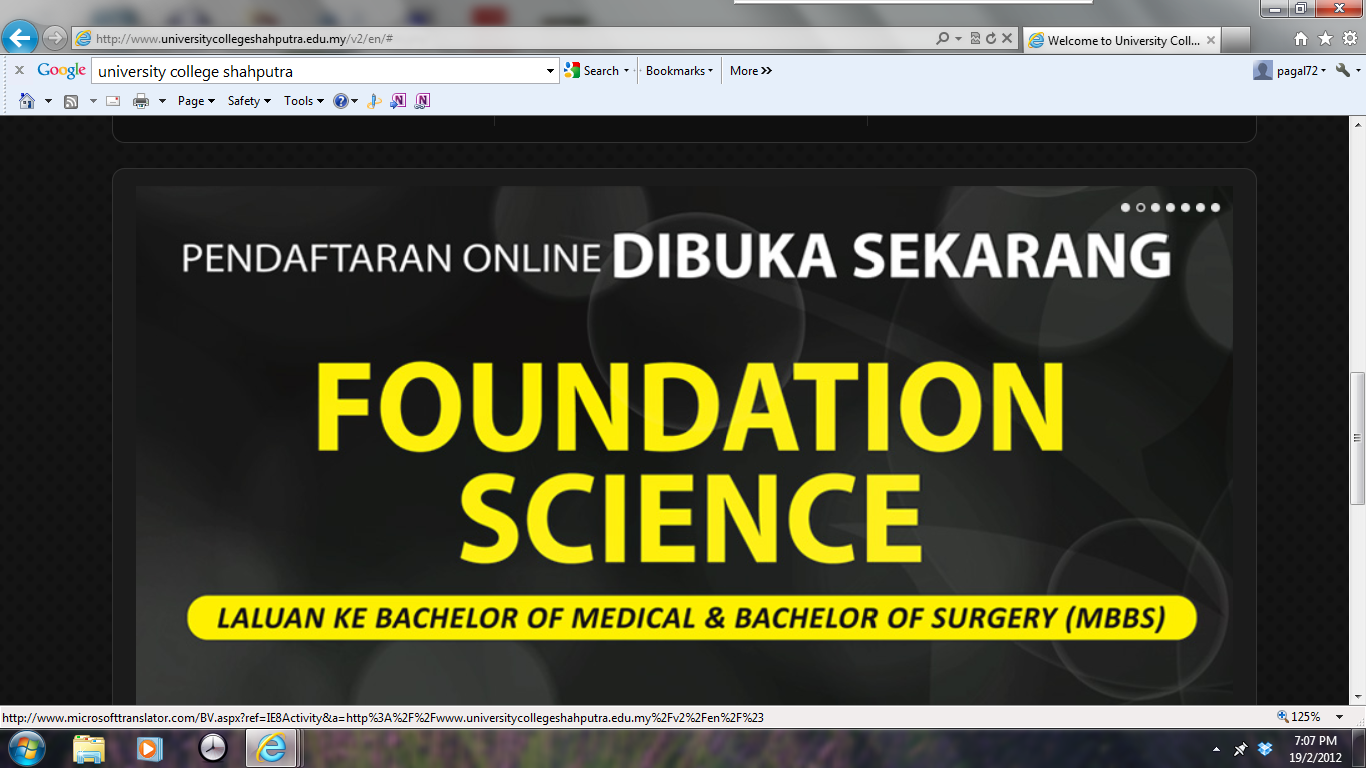





 Pagalavan's Avatar