Feeds:
Posts
Comments

The article below appeared in NST today http://www.nst.com.my/opinion/columnist/enough-doctors-in-the-house-1.66656#ixzz1qJoGh1k4. It looks like it is slowly coming out of the bottle. Even though the issue of oversupply of doctors did appear last year, it died off slowly when the “so-called” moratorium was implemented by the cabinet. The moratorium ended up as a joke after that! The article below has some mistakes. The number of medical schools is currently 36 in total and not 30 as mentioned. The total of medical programmes will be more than 40 as many are running 2-4 concurrent medical programmes as mentioned below as well.

The reasons given by our Deputy Health Minister for the increase in number of doctors in civil service: “Among the reasons for the big number, she said, was that more government  scholarships were available for medical studies (from 600 to 800 per year) and  more openings for medical practitioners in the ministry’s health facilities” is laughable. The number of post in civil service has not changed much over the last few years. What has clearly increased is the production of medical graduates.

And if you think it is going to stop at 36, please read the article below the NST article  http://thestar.com.my/education/story.asp?file=/2012/3/25/education/10961119&sec=education which appeared in the Star last Sunday 25/03/2012. The deputy director of Higher Education said this: “About 25 more institutions have indicated their interest but we want to be selective and work with those who are specialists in their fields such as in Medicine, Engineering or Business programmes” WTH!! in the name of education hub!!

I received an email from an unhappy budding doctor who said that I am painting a negative picture and breaking the heart of many aspiring doctors who have genuine interest in doing medicine to help people.  “in your posts, you also pointed out the fact that doctors now have little or no job security as posts are limited which really dampens our ambitions as even if our intentions were true, to genuinely comfort and assist people in need, with no posts available in the next 5 years, or opportunity to do so, really discourages students like me to even consider it as it seems like pursuing medicine is now a dead end!” 

The facts are right infront of you and it is up to you to decide on your future. There is nothing special about medicine that you must be guaranteed a job! It is just like any other profession where you need to look for a job. The only difference is that medicine is more complicated than any other professions as I have mentioned numerous times before. No government promises you a job. Thus, if you have genuine interest in medicine and not for money, go ahead but be prepared to have a tough life ahead. That is what I am trying to say.

Enough doctors in the house?

By Syed Nazri  | syedn@nst.com.my

ANNUAL RUSH:   Malaysia could be heading for a glut in  five years, say practitioners

THIS is the time of year when so many young Malaysians run towards realising  childhood ambitions, and parental pressure, of becoming a doctor.

Everyone among them seems to want to be a doctor, lawyer or an engineer,  though several years down the road, some might end up being an overworked  politician or an underpaid reporter.

It is the transformation season, one that follows the completion and outcome  of the Sijil Tinggi Persekolahan Malaysia and Sijil Pelajaran Malaysia  examinations. More than half a million of them will start looking at what they  are going to do next. And it’s quite certain that hundreds, if not thousands,  will seek to take up courses related to medicine on their way to becoming  doctors. The straight A+s in SPM came up to almost 600, and that’s only a small  fraction of the doctor hopefuls.

It happens every year; if the high achievers don’t get government  scholarships to do these courses, they will make noise, call up overworked  politicians or write to the newspapers.

But let’s look at things in another perspective and consider what was  revealed in Parliament last week by Deputy Health Minister Datuk Rosnah Abdul  Rashid Shirlin and match it with what doctors themselves think.

Rosnah said: “The number of medical practitioners in the country has  increased significantly with the ministry registering over 21,747 in government  service last year.” (It was recently also reported that there are about 33,000  overall).

Among the reasons for the big number, she said, was that more government  scholarships were available for medical studies (from 600 to 800 per year) and  more openings for medical practitioners in the ministry’s health facilities.

Now, let’s ponder over what came out in the latest issue of Berita MMA, the  monthly newsletter of the Malaysian Medical Association. The following is an  excerpt of an article written by Datuk Dr N. Athimulam. I was told it reflects  the views of most, if not all, doctors. It’s really hot off the press in more  ways than one:

“As per Dec 30, 2011, there were 11 government and 19 private medical  colleges, with about eight offshore recognised medical programmes. The strength  of medical students in each medical faculty varies. Two private colleges in the  southern region with twinning programmes have 1,457 students here and another  1,229 overseas, with a total of 2,686. A newly opened prestigious private  university college has a total of 95 medical students.

“On an average, if there are 500 students in each college, then there should  be 15,000 medical students in Malaysia,” Dr Athimulam, a past president of MMA,  wrote.

He added that about 10 years ago, the authorities introduced a requirement  referred to as NOC (no objection certificate) to regulate the number by making  sure that only really qualified students could take up medicine.

This ruling, however, has not been adhered to. And as a result, he said, the  number of Malaysian medical students overseas has increased to “easily more than  25,000”, mostly in the Middle East, Indonesia, Russia and Ukraine.

Dr Athimulam further wrote: “The government intends to achieve a target of  87,177 doctors by 2020, by which time the country’s population is projected to  be 35 million.

“The Health Ministry has set a target ratio of one doctor to every 400  people by 2020”, but he expressed fear that there could now be as many as 10,000  medical interns every year, which means that the government target for 2020  “will be reached by 2017”.

Then the cruncher: “Unless the government controls medical education, there  may be a glut of doctors by 2017 or 2018.”

The way things are going, I don’t know for sure whether it is good or bad.  On one hand, Malaysians aspire to take the country to become a developed and  high-income nation in a few years.

Which means a sufficient number of doctors.

But on the flipside, are we doing it the right way and not compromising on  quality?

Whatever it is, this paper is offering a timely service to post-school  Malaysians about career choices and the right courses, including medicine.

The New Straits Times will publish a weekly pullout starting today that will  serve as a guide to students intending to pursue higher education. Be sure to  get your copy.

Read more:  Enough doctors in the house? – Columnist – New Straits Times http://www.nst.com.my/opinion/columnist/enough-doctors-in-the-house-1.66656#ixzz1qJoGh1k4

M’sia set to be education hub

By KAREN CHAPMAN educate@thestar.com.my

The country aspires to become the regional learning centre by focusing on its strengths in four key areas.

THANKS to a landmark partnership agreement between the Higher Education Ministry, Universiti Teknologi Mara (UiTM) and the world-renowned Massachu­setts Institute of Technology (MIT), the country is set to become the knowledge capital for logistics and supply chain management in Asia.

 Dr Mahender says a supply chain comprises everything involved in creating a product, from raw materials to finished goods.

This has resulted in the formation of the Malaysian Institute for Supply Chain Innovation (Misi) in Shah Alam.

Dedicated to postgraduate supply chain education and research, Misi will serve as MIT’s Asian hub in the university’s international network of centres, which is known as the Global SCALE (Supply Chain and Logistics Excellence) Network.

The other centres in the network are the MIT Centre for Transportation and Logistics (MIT CTL), the Zaragoza Logistics Centre in Spain and the Centre for Latin American Logistics Innovation in Colombia.

Modelled after a leading supply chain management programme at the MIT CTL, Misi rector Dr Mahender Singh explained that Misi will offer both Master’s and Doctoral programmes in supply chain management and logistics.

“The Master’s programme will start in August this year while the Doctoral programme is scheduled for next year,” he said.

In addition, Misi will offer short courses under its Executive Development Programme as well as conduct research and corporate outreach activities for global and local firms that operate in the Southeast Asia region.

“The MIT Global SCALE Network is an international alliance of leading-edge research and education centres, dedicated to the development and dissemination of global innovation in supply chain and logistics. It was launched by the MIT CTL with the opening of the centre in Spain in 2004 followed by another one in Colombia in 2008.

“Collectively, the SCALE Network, which includes CTL, now spans four continents,” he said.

 Prof Siti Hamisah says the ministry wants to be selective when deciding on a foreign branch campus to be set up in the country

Explaining the meaning of supply chain education and research, Dr Mahender who has been seconded from MIT, said supply chain management (SCM) is one of the key areas within the business management space.

“A supply chain comprises everything involved in creating a product, from raw materials to finished goods. It is the art and science of bringing raw materials from their source, converting it into products and moving them to the multiple consumer locations in the most efficient manner to make the business profitable.

“We teach students a variety of skills since the domain of SCM needs a very diverse set of capabilities,” he said.

The students learn quantitative as well as qualitative methods to make supply chain performance improvements. The complexity in supply chain arises due to the routine movements of products and service across country boundaries.

“The students also learn about the financial and informational aspects of the business as it relates to the performance of the supply chain directly,” he added.

Using the actual data and description of their problems, he said researchers may decide to use mathematical tools to model the problem and find a better way to find a superior solution, or devise better solutions after conducting a qualitative analysis of the available data.

The signing of the landmark partnership agreement was witnessed by Prime Minister Datuk Seri Najib Tun Razak last year, who commended the three parties for their efforts, which supported the nation’s aspirations to strengthen higher education and to be a regional education hub.

“With Misi’s establishment, I believe that research and development in logistics and supply chain industry will propel and accelerate other industries for the benefit of the nation,” said Najib at the time.

Higher Education Minister Datuk Seri Mohamed Khaled Nordin said it was heartening that MIT chose Malaysia to host its overseas centre.

“The partnership is significant because China and Singapore had expressed interest in hosting the centre,” he said.

He said the ministry had selected UiTM to be MIT’s partner as the local university had a long history of offering transport and logistics programmes up to postgraduate level.

In terms of higher education institutions as of October last year, there are 20 public universities, 26 private universities, 23 private university colleges, 28 polytechnics, 74 community colleges, 434 private colleges and several branch campuses of foreign universities.

On the possibility of setting up more branch campuses of foreign universities here, Higher Education Ministry deputy director-general (private higher education institutions) Prof Datin Dr Siti Hamisah Tapsir said the ministry wanted to be more selective when doing so.

Working with the best

About 25 more institutions have indicated their interest but we want to be selective and work with those who are specialists in their fields such as in Medicine, Engineering or Business programmes,” she said.

Giving examples, she said these included the partnerships between Misi and MIT, Perdana University and Johns Hopkins University and Royal College of Surgeons, Newcastle University Medicine Malaysia, Southamp­ton University and Reading University.

“Heriot-Watt University will set up a branch campus in Putrajaya,” she added.

According to the Heriot-Watt University website, it has been chosen to establish a new campus in Malaysia at an investment of £20mil (RM98.4mil).

It said the university was chosen as winner of a major international tender by the Malaysian Government and Putrajaya Holdings Sdn Bhd, in recognition of its strong reputation for creating diverse research and development opportunities and solid strong track record of success in linking with industry, commerce and the wider society. The new, purpose-built campus will create opportunities for up to 4,000 undergraduate and postgraduate students to study a range of courses in science, engineering, business, mathematics and design, with a view to gaining a UK-recognised degree.

Recent figures show there are 87,322 international students in Malaysia (24,617 in public institutions and 62,705 in private institutions). 9,002 of these international students are pursuing PhDs, 11,673 Masters and 35,347 their Bachelor degrees while the rest are attending diploma and certificate-level courses.

The ministry is targeting 200,000 international students enrolled in the country’s higher education institutions by 2020.

Prof Siti Hamisah said the Government is planning to expand the roles of its Education Malaysia offices (formerly known as Malaysian Students’ Department (MSD)).

“It will be like a one-stop centre where foreign students can seek more information on studying in Malaysia as well as better able to handle the recruitment of foreign students. It is similar to British Council,” she said.

To become a higher education hub, Prof Siti Hamisah said the ministry has identified four areas that will put the country in a better position to attract foreign students.

These are Islamic banking and finance, advanced engineering, hospitality and health sciences.

Mohamed Khaled said last year that by focusing on the four key areas rather than in too many disciplines, Malaysia would be able to strengthen and develop its position as a higher learning education hub.
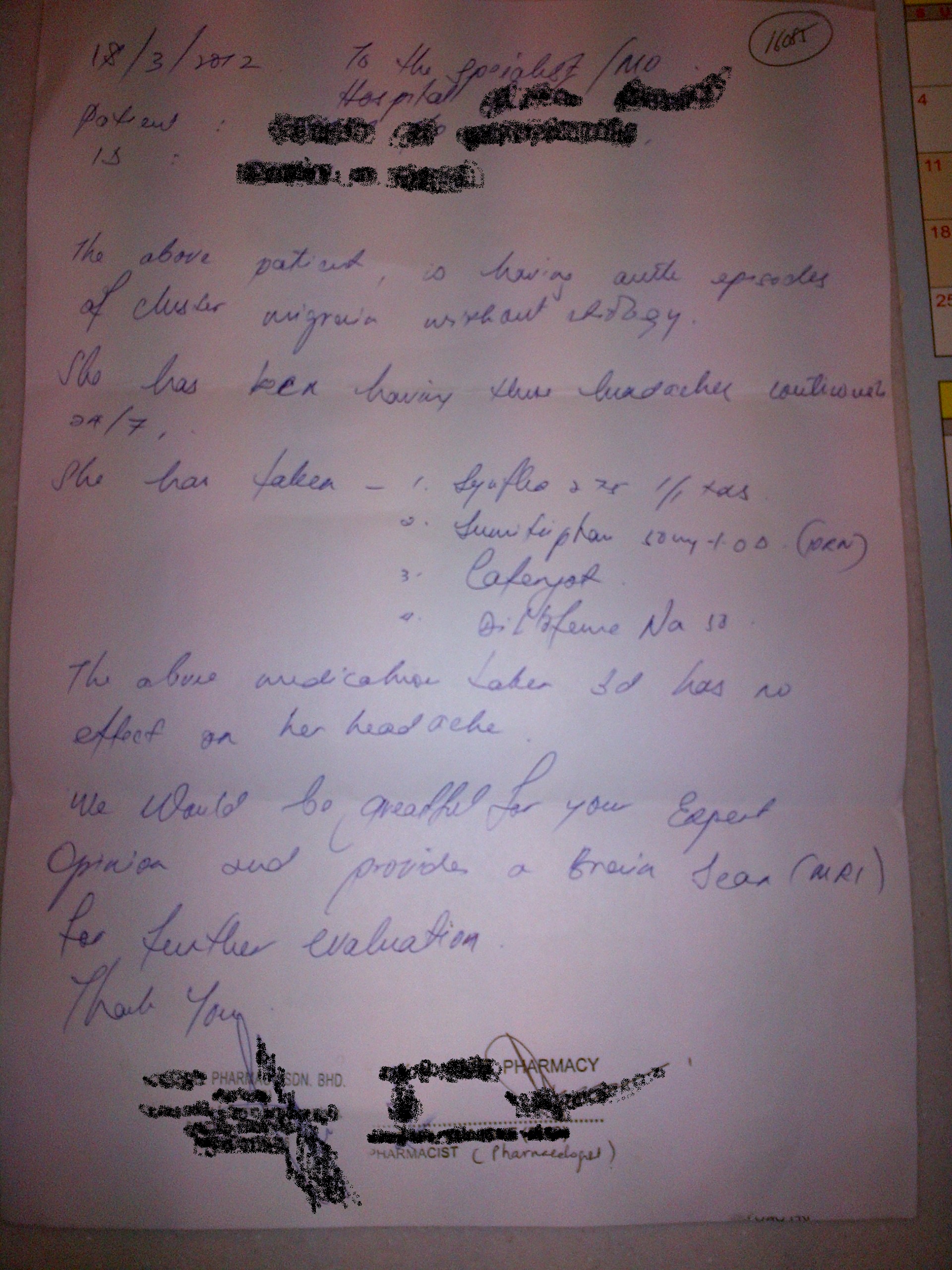
Today, I received an interesting referral letter, not from a doctor but a pharmacist! The letter was actually directed to a government hospital but the patient decided to come and see me.

It is interesting to see that a pharmacy can treat patients and even write a referral letter to the hospital !!. According to the patient, they saw a “doctor” but I don’t see any doctor’s name in this letter. Only a pharmacist has signed the letter. I presume the pharmacist was wearing a white coat and thus the patient thought he or she is a doctor. The pharmacy has been prescribing medications for this patient over the last 1-2 weeks and decided to refer to the nearest government hospital with a plan : “provide a brain scan (MRI)”. I also like this sentence ” cluster migraine without etiology“.

The issue of pharmacists acting like doctors has been going on for a long time but unfortunately the enforcement is really weak. Even though raids are conducted but very minimal. Pharmacist is not allowed to diagnose, do investigations and treat patients. Their job is just to dispense medications on doctor’s prescription and to explain the side effects of the medications. They also act as  an adviser to the doctors in terms of dosages etc. I have seen pharmacist who even conduct routine  blood sugar, HBA1c and BP monitoring for patients. They even adjust medication dosages and prescribe new medicines, taking over GPs work.

I can only see this situation getting worst as pharmacist are also learning to survive. Soon, they may even employ our jobless doctors to work with them as an adviser! Who knows? anything can happen in this bolehland……………….. I am going to send this letter to MOH and see what action they are going to take.

Yesterday (18/03/2012), the Malaysian Medical Association Johor Branch had its AGM for 2012. It was a special occasion as the President of MMA and the SCHOMOS Chairperson were present to have a dialogue session with all the members. It was a fruitful meeting and many issues concerning the medical fraternity were discussed. We also got to know the latest happening that will change the future of medical profession in this country.

1)      Housemanship

 The declining standards of medical education and oversupply of doctors were discussed. It is indeed true that the number of housemen is reaching an unimaginable level and MOH is very much aware of this. To cover this up, MOH has come up with the shift duty system and to allocate more district hospitals for training. Most hospital’s housemanship post is fully occupied. The ratio of housemen to specialist supposed to be 5: 1. Unfortunately, the way MOH calculates this figure is rather odd as they include all specialists in the hospital including radiologists, pathologist, ophthalmologist, ENT surgeons etc where housemen are never placed. So, in reality there are not enough trainers for all the housemen who are currently in the system.

The oversupply of doctors is a harsh reality which is going to happen anytime soon. MMA has discussed this issue with MOH but unfortunately MOH puts the blame on MOHE. The moratorium is just eyewash. It is very clear that it is all about money and the only people who can stop this rot will be the general public and not MMA. Whenever MMA brings up this issue to MOH or MOHE, they are accused of being selfish and avoiding competition! Thus, it is very clear that they want to flood the market with doctors and no one is going to guarantee you a job.

The maximum period to complete your housemanship is 3 years. Anyone who does not complete the housemanship in 3 years will be automatically terminated.  Any houseman who is caught doing “locum” will be automatically terminated.

It is indeed true that MMC may soon remove the 4 years compulsory service under pressure. It is no more a rumour as I have mentioned before. It basically means that after 2 years of housemanship which is given on contract basis, there is no guarantee that you will get a job. You will have to apply to get a job in civil service or open a clinic (with license to kill). You can also forget about postgraduate education if you do not get a job in public sector.

2)      Postgraduate education

It is also true that you are only eligible to apply for Master’s programme on 5th year of service (2+3 years). The number of Master’s post is gradually being increased due to political pressure. It is way too many compared to what the universities can really handle. The quality of Master’s graduates is slowly dropping and many consultants in hospitals have voiced out their concern. We are now seeing Master’s graduates who can’t do simple surgeries. Fresh Master’s graduates are teaching Master’s students in the universities!

Those who quit Master’s programme or who failed 4 times (meaning disqualified) will still need to serve their bond with the government and repay the JPA scholarship.

3)      Insurance companies

One of the GPs brought up the issue about insurance companies cutting the consultation fees and threatening doctors. It seems that many of these insurance companies and MCOs are requesting doctors to reduce their fee if their contract is going to be renewed. If you refuse they will find another GP who is willing. The situation has reached a critical stage to the extent that some newly opened GP clinics are willing to be paid only RM5 per consultation!! How desperate the situation has made of some doctors!

With the removal of compulsory service, many of these unemployed doctors will end up opening a clinic to survive. These doctors would probably even accept RM1 per consultation! Someone in this blog commented about competition some time ago, so here you are………..

It basically means that doctor’s income will gradually reduce and many may just earn enough to survive. It is also unavoidable that the dispensing rights of doctors will eventually be removed.

The 1Care system is still in planning stages and nothing has been finalised. So, we just have to wait and see.

4)      Liberalisation of Health Sector

In Budget 2012, our PM has announced the liberalisation of many subsectors which includes health sector. The MMA has voiced out its concern regarding this matter as proper monitoring mechanism is not in place yet http://www.themalaysianinsider.com/litee/malaysia/article/mma-putrajaya-gambling-with-nations-health-by-liberalising-medical-sector/. Unfortunately, it is unavoidable once again. Since February 2012, the government has allowed private hospital of 100% foreign equity to be set up in Malaysia. They are also allowed to hire foreign consultants as long as their degree is recognised by MMC/NSR. By September 2012, foreign specialist/doctors will be able to set up their clinics in Malaysia!!

Unfortunately, the amended Medical Act 1971 is yet to be tabled in Parliament. Thus, the National Specialist Register (NSR) is not compulsory at this point in time. So, where is the monitoring system to make sure that these “so-called” specialists are indeed what they claim to be? Someone can set up a “proctologist” clinic beside yours and earn a decent living! Even now, there are some private hospitals which are hiring “so-called” specialist “trained” in some other country without NSR registration. Private hospitals are profit driven and what they are interested is only money and not quality. With the poor monitoring system, these doctors can easily get away with whatever they are doing and the rakyat will eventually be the victim.

Over the last 24 months since I started blogging I have been constantly saying that the future is bleak for doctors. Guaranteed job, good money and life are the reasons why many choose medicine. That is the fact! Forget about helping people, curing the sick etc which is actually the minority. Whatever said, at the end of the day, it is a profession to earn a living. Unfortunately, many people believe that just because they spend RM 500 000 to RM 1 million to do medicine, the return of investment is high!! It is a total misconception that the public is totally unaware.  Our society is just obsessed in getting their children to become a doctor for glamour and social status. That must change!

Secondly, doctors are so disunited that the government can just do what they want. The only organisation that we have is MMA but unfortunately how many of you guys who are reading this are even members of MMA? How many of you are even interested to fight for the betterment of future doctors? I have done my part and still contributing to the betterment of doctors in this country. I created this blog to educate the public/future doctors as I realised that many are not aware the mess that they are getting into. MMA received a lot of bad publicity recently but it is still the only organisation to fight for doctors.

The future is indeed bleak……………………….

 I received this interesting link today: http://www.telegraph.co.uk/health/healthnews/9138415/Doctors-could-face-GMC-action-for-ignoring-poor-care.html. If this were to be implemented here, many doctors may be jobless! I see mismanagement and misdiagnosis on a daily basis , both from public and private sector. I am not saying that doctors don’t make mistakes but a poor care to any patient can be penalised. According to this regulation implemented by GMC today, any doctor who witness poor management of case by another doctor should report it to GMC. If not, you will get into trouble as well for compromising patient safety.

Unfortunately our MMC is not as effective as GMC. One of the reasons could be the fact that MMC comes under Ministry of Health and the DG automatically becomes the chairman. If you visit MMC website http://mmc.gov.my, you will hardly find actions being taken to doctors ( there are a few but mainly due to falsification of documents). It could be due to the fact that not many patients or doctors complain about another doctor. When the new amended Medical Act is tabled in the Parliment(hopefully soon), MMC will be corporatised and I hope it will become more effective.

We also do not have a compulsory Specialist Register. Even though National Specialist register(NSR) www.nsr.gov.my was launched in 2006, it was not made compulsory yet as the the Medical Act need to be amended. Unfortunately, even before all this monitoring mechanism is in place, the government has allowed doctors who have been in service for more than 10 years overseas to return without the need for compulsory service. Thus, these doctors can go straight to private sector! I am now hearing news of some private hospitals recruiting “so-called” specialist “trained” in a particular country and credentialing them as specialist/consultants to make money. These private hospitals do not make any attempt to make sure whether these ” specialist” are really what they claim to be. I am already hearing horror stories from these hospitals but yet the management of these hospitals are not bothered as money comes first! Imagine doing FESS surgery for 4 hours! They seem to claim that they can do all sort of surgeries etc but in reality it’s all talk but no action! The management of the hospital even got a cheek to say that NSR registration is not compulsory! I was informed that MOH is aware but no action so far as patients did not make any complain.

I just hope MMC will implement more drastic measures to monitor quality of doctors in this country, have more teeth and not to succumb to political pressures. The NSR should be made compulsory for private hospital’s consultants till the medical act is amended.

 Doctors could face GMC action for ignoring poor care

Doctors could face disciplinary action if they “walk by” and ignore poor patient care by other doctors or health professionals, under new General Medical Council guidelines coming into force today.

Doctors could face disciplinary action if they “walk by” and ignore poor patient care by other doctors or health professionals Photo: ALAMY

1:33PM GMT 12 Mar 2012

The new rules mean they may be held to account for failing to raise concerns about sub-standard treatment even if they are not involved. Doctors will be seen as responsible for the “entire welfare” of patients.

Chief executive Niall Dickson said it followed examples such as the scandal at Mid Staffordshire NHS Foundation Trust, where up to 1,200 “excess deaths” occurred due to poor care.

While some doctors did report their concerns, others “walked by on the other side of the ward”, he said.

“Doctors have an obligation to raise these concerns when they see things are going wrong,” Mr Dickson added.

He said the new rules were intended to foster a “culture of openness” in which raising concerns was not just a matter of “heroic” whistleblowing but should be an every day part of working in the health service.

Mr Dickson told BBC Radio 4’s Today programme the guidance was meant to be “more carrot than stick” but that it was “guidance with teeth”.

“Doctors who persistently and seriously depart from this guidance will find themselves possibly with their careers at risk.”

He added: “You can look at examples at the Mid Staffs inquiry, where although some doctors did raise concerns, it is also clear that many doctors didn’t raise concerns, that in a sense they walked by on the other side of the ward.

“That’s not to say that the medical care itself may have been bad, it may have been bad care by other care professionals, but our advice is that doctors have a wider responsibility.

“They have a responsibility not just for the care they give, themselves, but also for ensuring the entire welfare of patients and that includes care provided by other doctors but also care provided by other professionals

“They have an obligation to raise concerns when they have them, and doctors who are in management positions also have a responsibility to act when those concerns are raised.”

The new guidance also bans doctors from signing contracts with gagging clauses that attempt to prevent them from reporting problems to the GMC or other regulators such as the Care Quality Commission.

Mr Dickson said there were “odd” examples of such contracts which appeared to have resulted when “HR departments get some advice from lawyers” to “absolutely seal this thing up”.

He added: “What we want to encourage across the health service and indeed the private sector is a culture of openness where people feel that raising concerns is not just about whistleblowing.

“It is not just about an heroic act, it should be part of every day culture. That’s the only way in which patients will be protected.”

Two days ago, someone by the name of ThiruKCS wrote a letter to at least 3 medias, namely theStar http://thestar.com.my/news/story.asp?file=%2F2012%2F3%2F8%2Ffocus%2F10874444&sec=focus, Malaysiakini http://www.malaysiakini.com/letters/191405 and FreeMalaysiaToday http://www.freemalaysiatoday.com/2012/03/08/the-darker-shades-of-a-houseman%e2%80%99s-life/. I got no idea what he is trying to say and what is his intention but he sounds desperate!

I will say this again that if you want good, nonstressfull life, then go and find another job! Being a doctor needs a lot of commitment and stress management as life’s are at stake. If you can’t handle that, you can always quit and find another less stressful job. The last I can remember, housemen are doing shift duties now! so, if even shift duties are still stressful, then what does this guy wants? Does he really think that other jobs are less stressful and have better life? No doubt that the others may not be dealing with life but do you know how many hours an accountant spends doing accounts, a lawyer spends in preparing a case etc etc? Every job has it’s stress but medicine is different in the sense that it deals with life and since you chose this job voluntarily (hopefully by knowing all these before), you just have to go with it and learn how to cope.

There is no such thing as “office hour” job for a doctor. You need to make sure that every of your patient is well and properly managed before you leave the ward! That what makes you a good doctor. Of course, I am not saying that you should work 36 hours straight but working shift hours does not mean your responsibility is less! The stress of doctors only increases as you go higher in hierarchy as the responsibility increases. And don’t forget the litigation rate and lawyers ever waiting to sue you. BTW, where did he get the figure that 60% of housemen are having psychiatry disorder? That means 6 out of 10 housemen are mentally ill!! That’s scary. Are these the people who are going to treat us/public in the future?

BTW, this guy has just come up with a new theory for a cause of Cushing’s syndrome: Housemanship. So, medical students can now put this as a differential diagnosis. “Medical studies have determined that stress causes our bodies to produce more Cortisol. This “stress hormone” is normally only released into our bloodstreams in emergency situations. When we become scared or excited, Cortisol is flooded into our bodies to help us deal efficiently with the situation. Too much of this hormone in our bloodstreams can and does cause adverse health conditions. These conditions can include, but are not limited to, cardiac problems, strokes, obesity, a lower immunity system, and insomnia”  WTH!!

So, for those who intend to do medicine and expect a good job, good life, good future and good money, please think again. It is people who have this perception who end up writing these sort of articles to newspaper and making a fool out of themselves. This was one of the purpose of this blog, to educate the youngsters about medicine and being a doctor.

THis was one of the comment that I just received in my blog yesterday, by a housemen: “I realize that quality of doctor are dropping. Compare to senior 2-3 year older than me, i can see huge different between us. For example, during their HO time, maybe just 2 HO allocated in one 30- 40 patient ward,during my time it is 15 HO per ward. So, training is lacking.

Then, we also realize that our future was really unpredictable. After you complete your housemanship, where will you choice to go? I also find out that majority of the doctor will choose field which had relax life, they don’t mind to be a chronic MO, such as at KK, district hospital, or some posting with no active call like ENT, radiology, pathology, opthalmology, psychiatry. So, these posting become hot posting when it come to the time to apply as a medical officer there. When these posting are full of the chronic MO, then, it was a bit unfair for those who really had interest in the field and plan to be specialist there, because when a department is full, you will had to go to other department which you don’t really like.”

Asta Levista babe……………………………

The darker shades of a houseman’s life

<!–

March 8, 2012

–>March 8, 2012

FMT LETTER: From Thiru KCS, via e-mail

Lately, there has been a lot of discussion on the plight of medical house officers in our country who are compelled to work long hours uninterruptedly. The most important asset of a country is not its natural resources, but rather its human resources. This is especially true in a knowledge-based economy, which, of course, will be the trend in the future if not already the trend in most of the Western countries. When noble professions are ever discussed, the first that comes to mind is none other than medical doctors. The big unsolved question is that are we giving enough importance to this profession?

Stress and burnout are concepts that have sustained the interest of house officers and researchers for several decades. These concepts are highly relevant to the workforce in general and house officers in particular. Despite this interest and relevance, the effect of stress and burnout on patient outcomes, patient safety, and quality care is still at the tip of the iceberg when it comes to solutions and action plans.

The Employment Act 1955 (EA) mandates that overtime pay at double the normal wage-rate and triple the normal wage-rate must be paid when employees work on rest days and public holidays, respectively. I’m aware that civil servants do not come under the purview of the EA; and doctors, housemen and the medical fraternity in government service are specifically excluded due to “work, the performance of which is essential to the life of the community” [EA Section 60A (2)(b)]. It’s almost absurd when authorities are convinced that they have looked into the matter by comparing the improvements introduced from a decade back. The issue that crucially awaits justice is what could be done to further improve the lifestyles of these house officers.

The utmost important issue to be addressed over here, apart from the payments and incentives which has always been debated despite the rise in the cost of living is the quality of life that these house officers lead in their daily lives. As the flow of life force energy moves through the physical and emotional bodies, it can become imbalanced or blocked. Although the hazards associated with the prolonged hours worked by resident physicians and house officers have been documented in numerous studies, limited attention has been paid from the administrative point of view on how to curb this issue. It’s distressing looking at the rates of house officers that seeks for psychiatry consultation at an alarming 60% in total at year 2008. Is this the kind of situation that we anticipate being healthy for these group of professionals? I can safely call this a crisis that screams for immediate remedy!

The development of trust in the physician leads to a proper patient-doctor relationship and is part of the healing process. A major element necessary for patient trust is with an individual whom is able to respond to the patient with focus and diligently gather information from the slightest reactions exhibited by the patients; and this in no doubt is only possible when your mind and body is in synch. How would you even try to develop this professional relationship with your patients with these factors; red, puffy eyes and a haggard appearance, lack of mental clarity not mentioning your aching physical body!

Medical studies have determined that stress causes our bodies to produce more Cortisol. This “stress hormone” is normally only released into our bloodstreams in emergency situations. When we become scared or excited, Cortisol is flooded into our bodies to help us deal efficiently with the situation. Too much of this hormone in our bloodstreams can and does cause adverse health conditions. These conditions can include, but are not limited to, cardiac problems, strokes, obesity, a lower immunity system, and insomnia. An overworked house officer is prone to make unavoidable mistakes that would simply cause the lives of their patient not forgetting a huge blow to their career.

Based on current empirical evidence on stress and burnout in house officers, it is highly recommended that these issues are looked into precisely to enhance patient safety. May the relevant authority ensure that these public service doctors are happy and capable of providing the best service to the nation. So to the powers that be, wake up and smell the coffee.

Right from the beginning I felt something was not right about this SBPA. They way it was rushed, inadequate information given to government servants and short time period for signing made me to wonder whether the whole thing was a scam. Let’s go back and see what was announced in Budget 2012 http://www.treasury.gov.my/pdf/bajet/ub12.pdf in September 2011. At Page 24 and 25, a small announcement was made about SBPA. However what was made clear at that point of time was that there will be 7-13% pay adjustment with bigger annual increments of between RM80-320/year. The pay scale will be made as a single tier system and the maximum pay will be much more than SSM.

Then there was a total silence from JPA untill December 2011. Suddenly a circular was issued to all government servants to sign up for SBPA without proper explanation and without showing the pay scale. Stakeholders were never involved in the discussion! Most of the briefings given were inadequate and many civil servants were left in the dark. CUEPACS came into the picture and asked all civil servants not to sign the offer letter. Subsequently, the pay scale was released and woolah, a total mass was noted. The higher you are the better the pay adjustment. Civil servants with JUSA got 100% pay hike( about RM 6000-8000) and people at lower category like Staff nurses etc were getting only RM 70 pay rise. Attendants /Drivers were given RM 1-2 pay rise!! It was a total mess and I was not sure what actually happened as it was not in accordance to the Budget 2012 statement by the PM. I have 2 theories:

1) The JPA high-ranking officers decided to take all and push through the huge pay hike for themselves ( most PTD officers are usually U48 and above) when the election was around the corner. It is the best time to “black mail” the government . Basically, playing PM’s back. This statement in Malaysian Insider “However, the latest move raises questions about the internal processes within those in charge of the pay review and the Cabinet’s competency to digest beyond the headline figures presented to it when the entire wage scheme was being structured.The decision to scrap the SBPA is likely to also affect PSD director-general Datuk Seri Abu Bakar Abdullah’s chances of becoming the next Chief Secretaryhttp://www.themalaysianinsider.com/malaysia/article/government-scraps-civil-service-pay-revamp/ was interesting to note!

OR

2) The whole SBPA thing was a scam and an election gimmick? Announce huge pay hike, put on hold till March 2012 and call for an election in March 2012. So, the government servants got no choice but to vote the current government in order for SBPA to be implemented. Subsequently, after the election, PM comes up and say that SBPA is cancelled due to objections and only certain amount of pay rise will be given. Everyone knew that the election was initially planned for March but postponed due to the NFC scandal etc.

If indeed the SBPA was genuine, this will be one of the biggest flip-flop PM Najib has ever done since he became PM ! Anyway, I feel the current pay rise is reasonable and nondicriminatory.  So, with that, there will be some changes to my earlier post https://pagalavan.com/2012/03/01/for-future-doctors-government-doctors-salary/ . The HO salary will be almost the same but the U54 basic salary will be around RM 6000 and not RM 7110.

I was flipping through the latest Berita MMA magazine (Feb 2012) today and noticed a section on ” SCHOMOS meets Bahagian Perkembangan Perubatan and Bahagian Pengurusan Latihan” http://www.mma.org.my/Portals/0/Schomos%20Feb%202012.pdf. The situation is getting very critical as you can see. Firstly, the new rule says that you need to be in service for at least 5 years ( 2 years HO and 3 years MO) in order for you to qualify for local Master’s application. I had mentioned this earlier in my blog posting https://pagalavan.com/2012/03/01/for-future-doctors-government-doctors-salary/. Our current DG has come up with few more new rules and regulations.

Recently I received an email from a doctor saying that the DG has asked HODs not to sign up for any candidates who wants to sit for MRCP Part 3 if they have not spent at least 1 year in a medical department. I feel it is fair and it is very important for you to undergo adequate training before becoming a physician. In UK, MRCP is just an entrance exam for speciality training. The previous rule of at least 4 years of medical training ( includes 18 months of gazettement) before being gazetted as a specialist still stays but it was not strictly enforced before. I heard, it is being strictly enforced now.

The latest news is that you need to wait for atleast 2 years after gazettement before going for subspeciality training. Initially I thought the 2 years included the gazettement period but I was wrong! Even though it is good for the specialist to master the general speciality before going for subspeciality training, worldwide the duration of training is being shortened. I feel it is way too long.This means that to enter subspeciality training the total duration of service will be a minimum of 8 years for MRCP holders with subsequent 3 years training to become a sub-specialist ( total 11 years minimum), assuming you get your sub-speciality post immediately which is rather unlikely in popular specialities. As for Masters, with the implementation of the above 2+3 criteria, it will take 11 years of service before being able to enter subspeciality training with a total of 14 years to become a sub-specialist!! Remember that other than MRCP( internal medicine), MRCPCH(paediatric) and MRCOG ( Obstetrics and Gynaecology), the only way to become a specialist is via the local Master’s programme.

The SCHOMOS article also says that it is compulsory for newly gazetted specialist to serve rural area , namely Sabah and Sarawak for atleast 6 months as I have written before https://pagalavan.com/2012/02/08/for-future-doctors-panduan-penempatan-dan-pertukaran/. As you can see, what I have been saying all this while is becoming a reality. Our postgraduate education will not be able to cope with the glut of doctors that are being produced. Thus, the knee jerk reaction by our great administrators will be to prolong the training period, force people to serve certain areas and increase the bonding periods ( you will be bonded 5-7 years for Masters and 3-5 years for subspeciality training).

The “Foot in the Mouth syndrome” that is happening for the nurses now, will soon hit the medical field.  Then our great minister will say ” we need specialist but the medical colleges are only producing general training doctors. That’s why we have surplus of doctors!!” WTH.

The storm is coming and it will hit us hard. The way I see it, there’s going to be a huge number of “chronic ” medical officers running around without postgraduate opportunity ( only 10% will get it). Of course, many may not even get a job soon!

My last article on this series was written on 12th November 2011. The article was about how private hospitals are managed in this country and what is happening lately in private sector. Consultants in private hospitals are NOT employed by the hospital as many presume. You are self-employed and your income depends on your charges. Generally, a consultant fee is only about 20% of the total fee that you pay when you leave a private hospital as a patient. Out of this 20% that the consultant earns, the hospital will take 10-15% as their administrative fee. So, you work to make the hospital rich!

 Towards the end of my last article, I mentioned that the incomes of many specialists in private hospital are gradually dropping due to stiff competition. That is the reality and you can see many consultants jumping from one hospital to another in Klang Valley. Same scenario will soon happen everywhere else.

 When the competition gets tougher, unethical practises will become a norm. Some consultants want to maintain their income and thus indulge themselves in unethical practises by cheating patients. In fact, some go into private practise just to make money at whatever cost, making use of our ignorant society. Many may not like what I am going to write in this article but the truth has to be told. I received this interesting email quite some time ago:

 “I would like to bring to the attention of the public the unethical practices of some doctors in private practice.

 An 8-year-old boy was brought to see me by his father after suffering from fever, cough and vomiting for 1 day. He DID NOT HAVE ANY ABDOMINAL PAIN. He was initially seen by a general practitioner who insisted that the father bring him to see ‘Surgeon G’ at a specific private medical centre in Kuala Lumpur. The father at first refused and had wanted to bring his son to the medical centre where he was born but relented when the medical practitioner said that ‘Surgeon G’ will order some blood tests and will send his son home with some medications.

However, when he brought his son to see ‘Surgeon G’, the surgeon examined his son’s abdomen and pressed so hard that he elicited pain. Then the surgeon told the father that the son had a perforated  appendix and insisted that he be operated the same night. The father was baffled because his son did not have any abdominal pain prior to that excruciating examination but he reluctantly agreed upon insistence by the surgeon. About 1 hour prior to the surgery, the father suspected that something was not right and he asked for his son to be discharged. He then brought his son to see me.

The first thing I noticed was that the boy had a slight cough but he was very active. His father told him to jump to prove that he did not have any abdominal pain, which he did with great enthusiasm. After a thorough examination, I was convinced that the boy did not have appendicitis and definitely not a perforated one. I treated him symptomatically for upper respiratory tract infection and sent him home with some medications. The father was outraged with what happened to his son earlier but he was relieved that his son was saved from an unnecessary surgery. Professionally, I could not  tell him that ‘Surgeon G’ may have tried to cheat him but, in my heart, I knew that was the case because I knew ‘Surgeon G’ very well and had inherited a few of his patients whom he operated upon and had botched the surgeries.

The next day, ‘Surgeon G’ called me and asked what happened to the patient. I told him I was certain that the boy did not have a perforated appendix but he insisted that the boy was very sick and had rigors (severe shivering) when he first saw him. Surgeon G said the boy improved tremendously after one dose of antibiotics. In my years of practice, I have not come across one case where one dose of antibiotics can cure a case of perforated appendicitis. IT IS JUST NOT POSSIBLE! He also said that the boy’s father was a liar and had lied about his son not having any abdominal pain. Well, dear readers, I am a parent too. No father will lie about his son’s health because he would have wanted the best treatment for his son.

I suspect ‘Surgeon G’ is giving kickbacks to many general practitioners to send patients to him to operate. In return, he would pay these general practitioners for each patient referred to him. He would cooperate with the general practitioners to convince the patients that they need urgent surgery.  I have personally worked with ‘Surgeon G’ and I know that his skills are questionable. He told me once that it is alright for a patient to have a recurrent disease as a result of his incomplete surgery because he would then refer the patient to another surgeon to tackle the problem. He had caused one death from a thyroid operation and at least 2 cases of complications after galbladder surgeries which he refused to admit fault. In his clinic he has medical books with pictures of dangerous diseases which he uses to scare his patients into accepting surgery.

I am writing this to alert the public that there are doctors who are out for money only and are unethical in their practices. It breaks my heart that there are such individuals practising freely and fleecing off  unsuspecting and vulnerable patients and giving this noble profession a bad name. The only defence patients have is to be knowledgeable about their own illnesses and not be afraid to ask questions. All patients have to right to a second opinion and no doctors should coerce their patients to accept treatment against their will. The only consolation I have is that most doctors, both in public and private practice, are still ethical and are sincere in helping their patients.

Please circulate this article to your friends and loved ones and let’s hope no one will suffer in the hands of surgeons like ‘Surgeon G’. Also, beware of the general practitoner who insists that you see a particular specialist in a particular hospital because he could be working hand-in-hand with that doctor.”

Unfortunately, due to survival, many doctors are doing what is mentioned above. I even hear jokes at times that people around certain particular hospital got no appendix! This is because everyone who goes to this hospital with abdominal pain, vomiting or diarrhoea will have their appendix removed!! Few years ago I had a 16 year old girl who went to a private hospital for vomiting. She had an appendicectomy. She was still vomiting after discharge and was brought to government hospital 2 days later. When I asked her whether she had any abdominal pain, she clearly denied. It seems the consultant pressed her abdomen so hard that she had pain. It turns out to be that she was pregnant!! A simple history of LMP and a UPT would have given you the diagnosis. It’s all about money!

I have heard colonoscopy being done on a 16-year-old teenager who gets admitted for diarrhoea, which is just a simple acute gastroenteritis. Any patient with abdominal pain will have an Upper and Lower endoscopy done automatically if not an appendicectomy! Some doctors do not even examine the patient before ordering these investigations!!

It is very sad that the medical profession has gone so low just because everyone wants to make money. This is the reason why I keep saying that if you do medicine for money, eventually you will be carried away and unknowingly do unethical practices to sustain your income. Your motto of “saving lives” will remain a motto only. I will say this again : there is no money in medicine!! I have personally known specialist who are paying GPs to refer cases to them as mentioned in the email above. That could be the reason why certain GPs only refer their cases to a particular consultant in a particular hospital despite that consultant is not a sub-specialist in the field that is needed. That’s how desperate the consultants in private hospital have become.

I have had SLE patients with gross edema due to nephritis but the consultant in the hospital refuse to refer the patient to a nephrologist for a renal biopsy. Indeed, he was treating the patient with immunosuppressive agents without a renal biopsy (which is the standard practice)!! How unethical, but it happens. They rather take care of their pocket than the interest of the patient. Even though the specialist is not an expert in a particular field and the patient is still suffering from the illness, they still do not refer the patient to an expert! And they got no insight to the harm they have done to the patient. A good doctor will know his limit and would refer his patients out for the best level of care, whether to the government or another private hospital. He will not keep the patient to make money!

Also, don’t assume that all specialists in private hospitals are skilful. I have seen surgeons who can’t even do a simple hernia surgery but yet practicing in a private hospital. Most of the smaller private hospitals do not even have an ethics committee and what they want is just money. Whatever mistake or unethical practices that the specialist do, the hospital is not bothered as the hospital will just wash their hands off when the consultant gets sued (the hospital has already made the money!).

Do unethical practises occur in government hospitals? Rather unlikely but what I hated most when I was in the government service was when different and expedited treatment is given to VIPs! The VIPs were treated immediately and everything gets done fast. CT scans can be done the same day when general public have to wait for 3 months. I had always refused to entertain VIPs when I was in government service and my HOD was well aware of this.

I would say that partly the society is to be blamed for these unethical practices. Our society still has a lot of trust in doctors that they still feel that the doctor is doing the best for them. Fortunately, most still do but we are seeing more and more doctors who are cheating patients day by day. Unfortunately, our society believes that a doctor who says that nothing needs to be done as a useless doctor where as a doctor who removes an asymptomatic gallbladder is a good doctor! The public needs to be educated to do their own research and seek 2nd opinion when necessary before making a decision or they should ask for clear-cut evidence.

Sooner or later, the public will lose trust on doctors and the litigation rate will reach a very high level indeed. As you can see, the litigation rate is already going up day by day in major towns, especially in Klang Valley. Due to some bad apples, everyone will suffer one day………………….. and with the current quality of doctors being produced, the situation will only get worst………………

I came across the info below in one of the medical student’s blog (http://www.facebook.com/TheAvicennaProject). It seems the info was given to them when our MOH warlords met some of the medical students in UK. I think MOH should spend more time cleaning up their mess locally with oversupply and underqualified doctors.

Firstly, let me clarify that there are some mistakes in the info provided. No doubt that the new salary scheme that will be introduced soon (SBPA) will increase the basic salary of all government servants. This type of review will occur every 10 years. However I notice from the SPA website:  http://www.spa.gov.my/Portal/Deskripsi_Tugas_SBPA/Ijazah/1604 that the starting salary for Housemen ( if you do get a job) will be RM 2460 and not RM 26++ as mentioned. After adding all the allowances, the total will be RM 4660. After minus EPF(11%) and PCB (Tax), your take home salary will be around RM 3900. Your COLA allowance can vary between RM 150 and RM 300, depending on your location.

The time based promotion was announced in 2010 when SSM was in place. When SBPA was announced, there was no mention whether the same scenario will apply. I say this because the teachers had a totally separate circular when SBPA was announced where the time based promotion was clearly mentioned but this was not the case for doctors. NO separate circular was issued: http://www.jpa.gov.my/index.php?option=com_wrapper&view=wrapper&Itemid=137. Assuming the time based promotion is still applicable, you will reach U54 ( U1-6) after 12 years of service as a medical officer and 9 years of service as a specialist.

The assumption below that the salary for U54 MO will be RM 12000, is incorrect. Under SBPA, the starting salary for U54 (U1-6) is RM 7110 with Housing allowance of 900, entertainment allowance 800, COLA 300, critical allowance 750 which makes a total of RM 9860 before EPF and PCB deduction. If you are a specialist, the specialist allowance will be RM 2800. So, you will never get RM 12000 after 12 years of service as a MO. Your take home will be around RM 8200 for MO.

One info that surprised me is about Master’s application. It is mentioned that you can apply for Masters only after 5 years of service ( 2 years HO and 3 years MO). Well, I presume with the limited number of post ( 800-1000) per year and glut of doctors that are being produced, this is very likely to happen. That is what I have been saying all this while ( over the past 2 years) where only 10% of the doctors are going to get a post for postgraduate training.

After SBPA was announced, JPA did mention that the allowances will also be reviewed and many may be removed or adjusted. I have a strong feeling that some of the allowances will be removed. As for doctors, the critical allowance will be removed once all the posts are filled as what they did with the “on-call” allowance for housemen.

I was told recently that MOs are being sent to Klinik 1Malaysia now as I predicted a year ago. This is because most of the post in klinik kesihatan in major states are also becoming full. In Johor, all district hospitals MO post are full! I wonder what is going to happen in 3-5 years time when all our grandiose medical schools begin to produce graduates at maximum capacity?? you still think doctors cannot be jobless?

The recent jobless nurses scenario is a clear example. MOH has sent a circular to all private hospitals asking them to provide data on how many nurses they are employing and how many fresh graduates they have taken!! As I told you : ” Foot in the Mouth” syndrome…………………….. We have seen nursing graduates with no credit in Maths and Science in SPM!! WTH……………… it’s all about money, in the name of education hub…………………..

Wakil KKM:

Datuk Dr Norhisham Abdullah – Ketua Penolong Pengarah (sth sth)

Datuk Yahya

Wakil Talent Corp: Pn Shereen

Wakil JPA: Encik Amran

Students: Medic /dentistry/pharmacy students in UK

  1. Hospital baru yang bakal dibina/sedang dibina
  • Shah Alam
  • Parit buntar,
  • Kampar,
  • perak tengah,
  • dungun,
  • national cancer institute,
  • cataract centre
  1. 2.     Gaji
  • System gaji dalam proses transisi dari SSM (skim saran Malaysia) kepada SPBA (system saran baru perkhidmatan awam
  • SSM (dulu) : gaji pokok UD41 ( taxable plus minus 18%) = RM 2458, maksimum RM 5317
  • SPBA (sekarang): RM 26xx maksimum RM 6755
  • Gaji di atas tak termasuk allowance lain;

a)    Servis: RM 300

b)    Rumah: RM 250

c)     COLA: Rm 300

d)    Critical service: RM 750

e)    Hardship posting ( pedalaman ) : + 10% from basic , regional (borneo): =17.5% frm basic

f)     Oncall (fixed): RM 600

** allowance ini bertambah bila naik gred tangga gaji/specialist etc.

** BENEFITS: FREE MEDICAL SERVICE FOR PARENTS, SPOUSE & CHILDREN , PENSION AFTER 30 YR OF SERVICE; 60% OF FINAL SALARY, ANNUAL LEAVE; 25 DAYS, MATERNITY LEAVE: LADIES 90 DAYS, GENTS 7 DAYS. ELAUN PENGKEBUMIAN-RM 3000 (JIKA MATI- KIRA FAMILY  LAA DAPAT, DUIT TAK BOLEH MASUK KUBUR) NB!!- BENEFITS MAKIN BANYAK BILA GRED NAIK.

3. Promotion

  • Now, its time-based promotion, regardless of your performance, as long as you don’t have any disciplinary problems etc, you will be promoted according to how long you have served. ( macam GURU)
  • Selepas 2 tahun perkhidmatan- gred akan naik kepada UD44 (gaji naik ~RM 1000)
  • 3 tahun kemudiannya- gred UD8 ( tambah lagi ~ RM 1000)
  • 4 tahun kemudiannya- gred UD 52
  • 3 tahun kemudiannya- gred UD 54

( makanya, kerja dalam 12 tahun, kasar dapat dalam RM 12 000 termasuk elaun; kalau jadi specialist tinggi lagi laaa kot ^^ )

  1. 4.     Posting houseman
  • Selepas mtamat pengajian, lapor diri pada penaja, SPA dan pre-reg dengan MMC . Pre-reg sah untuk 3 tahun/
  • 6 postings wajib ( medicine, ortho, surgery, O&G, Paeds, AND anaesth OR A&E(posting akhir) )
  • Satu posting lebih kurang 4 bulan, posting ke-5 jika lulus semuanya boleh mula mendaftar untuk full registration dari MMC.
  • Sebelum setiap posting ada 2/52 of tagging, dan untuk computerized hospital seperti selayang plus 1/52 of tagging untuk ICT training.
  • Sekiranya bermasalah dengan kemahiran dll, masa posting akan dilanjutkan kepada 3 bulan lagi. Maksimum postings boleh kena extension- 3 ( kalau tak silap, sebelum di pertimbangkan untuk dilucut jawatan )
  • Masa lanjutan posting yang kali ketiga akan dilakukan di hospital lain.
  1. 5.     Sambung belajar.
  • Permohonan boleh dibuat setelah 5 tahun ( 2 tahun HO + 3 tahun MO)
  • Masters-  4 years program
  • Secara kasar, dalam setahun ada 800 tempat kosong ( keberangkalian 1/10)
  • Sekiranya, anda ditempatkan di Borneo dalam masa 5 tahun pertama, peluang anda semakin cerah.

7. Shift system

  • 8am-5pm: this is the prime time when teaching etc takes place, so, as much as possible they want everyone to be around during these hours.
  • The 1st shift: 5pm-12am. Kiranya continue from the day 8am until 12 am, pass over to the shift and off you go. 8 am tomorrow datang balik kerja.
  • The 2nd shift or “graveyard shift”: 12am-8am. Receive handover sampai pagi . Passover tapi kena stay dekat hospital sampai pukul 2pm baru boleh balik.


The news below made the headline in NST today. I didn’t know whether to laugh or cry! I will leave it to the readers to decide. Everyday, our politicians seem to be making a fool out of themselves. Our country is becoming a laughing-stock of the world!

I will say this again that it is all about money and some political connection. How many universities do we really need ? do we have that many academics to run these universities? when even our own public universities do not have enough teaching staff?

Anyone who works in these so-called ” universities” knows what hanky-panky things that goes inside. Just read this comment that was posted in my blog recently:

Dr P, my sister did A-levels as a prep course to study medicine in the UK in this college.. because MARA sent her there. basically MARA simply sent students to any new mushrooming colleges (to support these ‘bumiputra’ colleges) and take a gamble with their students’ future. my sister said the college knows nothing about a-levels for medicine. for medical school applications in the UK, the a levels students basically need confidential reports to be submitted and the teachers NEVER did it until the last minute when in the end they ASKED the student to write it themselves… it was really awful. the quality of teaching given was horrible that many students had to resit their papers due to poor grades, when these students were initially top SPM students. and not to mention accomodation provided as well… the standards were very poor. they tried to fit 14 students into one small single storey terraced house. for this college to start a medical school…its just unimaginable. “

I am very sure few more medical schools will be on the cards. Trust me! The politicians do not know anything about medical degree recognition etc etc. Even our PM is not aware about it ( how he made a fool out of himself when he launched Perdana University !: https://pagalavan.com/2011/05/21/is-this-a-joke-psd-students-among-100-in-first-intake-for-johns-hopkins/) Many of these foreign varsities just want to make money as the cost of education in their country is becoming too high for foreign students. Thus many are unable to attract foreign students to make money. So, they bring their brand name to our country and try to make money!

Education should never be politicised or commercialised! It is a disaster in waiting!

Welcome to the land of Varsities. We have not only recorded our name in Guinness World Book of Records as the country with most number of medical schools percapita and the fastest growing medical schools, we will be in as the country with most number of universities as well ………….

More varsities coming

25 apply to set up campuses in Malaysia Datuk Seri Mohd Khaled Nordin says the higher learning sector will boost Malaysia’s growth

MALAYSIA is morphing into a key destination for foreign universities, with 25 applications received to set up campuses here. Interest in the tertiary education sector has shifted to a higher gear, said Higher Education Minister Datuk Seri Mohd Khaled Nordin. The latest applicants allowed to set up campuses here were University of Reading and Heriot-Watt University, both from the United Kingdom. “We’ve even received applications to set up new private universities from established players although their internal policies don’t allow them to set up branches abroad. “There are also foreign investors who have no affiliation with any university, but keen to set up new universities in Malaysia.”

The Manipal International University and Vinayaka Mission International University College were instances of new foreign universities in the country. Universities that involve foreign entities are the Al-Madinah International University, INTI International University, Perdana University, Malaysia Institute for Supply-Chain Innovation and Raffles University Iskandar Malaysia. Khaled said many of the applications came from developed nations like the United States, Britain, Australia and Switzerland as well as from the United Arab Emirates, China, India, Nepal and Singapore.

He said he expected to receive more applications, especially from Europe and West Asia, following economic uncertainty and political discord in some of these places. “Investors set their sights on nations that promise good returns and stability for their investments. Malaysia offers these as it has a stable political and economic climate and is free from natural disasters. “We have a strong quality control system via Malaysia Quality Framework, undertaken by the Malaysia Quality Agency. We also have tax incentives and a liberal higher education policy.” Malaysia ranks 11th as the chosen destination for international students to further their studies. It controls two per cent of the total international students’ market. Khaled said the country had much to offer with its strategic location, infrastructure, large land deposit for development, lower operational costs and with English spoken widely as the second language.

“We have the Iskandar Development corridor in Johor and the Kuala Lumpur Education City in Negri Sembilan.” As such, Khaled said the higher learning sector was poised to be the key engine of growth as Malaysia moved towards a developed and high-income status. This had boosted the country’s reputation as one that possesses quality higher education on a par with developed countries and becoming Asia’s leading education hub, he said. “Foreign universities are careful and sensitive in their selection of locations to set up their campuses abroad. “When Malaysia is chosen by several world-renowned universities, it shows that our tertiary education sector has reached a higher level.” By 2015, more than 150,000 international students were expected to pick Malaysia as their choice, he said.

On whether having foreign campuses would threaten local institutions of higher learning, Khaled believed this would create competitiveness among universities. Most developed nations exported their higher learning products to expand their networks of cooperation to reach those in the developing and Third World countries, he added. To strengthen and boost the competitiveness of local universities, Khaled said the ministry had awarded autonomy status to Universiti Teknologi Malaysia, Universiti Malaya, Universiti Kebangsaan Malaysia, Universiti Sains Malaysia and Universiti Putra Malaysia. Read more: More varsities coming – Top News – New Straits Times http://www.nst.com.my/top-news/more-varsities-coming-1.50776#ixzz1nCfG17pp